The Knight-Wallace Fellowships has an impressive alumni network of nearly 750 journalists working around the world. The combined expertise of the group is a tremendous resource, and we want to make it easier to access. So we are adding an Alumni Locator function to our website, a simple tool that will provide the Who, What and Where of our extensive braintrust. We’re making the soft launch of the tool available now with information from recent classes, and we’re calling on alumni to help us make this a fully populated resource.
We know that part of what makes the fellowship year at the University of Michigan special is the degree to which Fellows learn from one another. We structure our program in a way that regularly brings Fellows together outside of classrooms and campus workspaces. During the academic year, Wallace House becomes a hub of activity for journalism seminars, skills workshops, meetings with special guests and public events. It is also a cherished gathering place for movie nights, Super Bowl parties, Tango lessons, cooking classes and a dizzying array of activities that knit our classes together and foster the network of professional support that makes our program so special.
Spending time together, without deadlines or structured conversations, allows Fellows to discuss their work and their journalistic methods, brainstorm their ideas and share aspirations and concerns about their future career paths. Our journalists become each other’s teachers, sounding boards and cheering squads. And the connections they form remain important when they return to their professional lives. We often get calls from Fellows asking for our help in reaching someone from another year. Sometimes it’s because they are switching beats and are in search of topical expertise. Sometimes it is because they are reporting in a part of the world they’ve never been to and they are looking for contacts and suggestions. The Alumni Locator will provide the answers through a searchable database.
Check out the Alumni Locator here. You can search for Fellows by location or subject matter.
We’ve designed this resource with multiple audiences in mind. Prospective applicants often want to reach out to former Fellows. And friends of the program often want to follow the careers of our journalists. A general view of the database allows those groups to see where our Fellows are around the world.
Knight-Wallace alumni will have password protected access that will allow them more layers of information. We’re soft-launching the tool with information provided by recent classes of Fellows.
To fully populate the database, we’ll need our alumni to provide us with the information they would like us to share. We’ll be gathering that information in the coming weeks and months, so that the tool can be fully functional by the end of the academic year.
We will have a lot of information to enter into this new database. Our hope is that by late Fall, if you need background information for a story, need to find a stringer in a new place or want to brainstorm about managing or funding a newsroom, you will be able to go to our website for quick and useful connections.
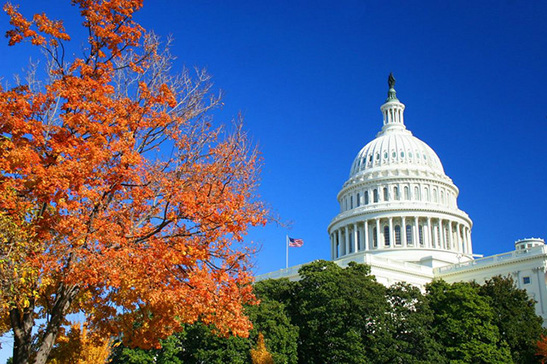
Knight-Wallace Fellows meet with leaders in the nation’s capital and participate at ONA.
International travel has long played an important role in the Knight-Wallace Fellowships, taking the mid-career journalists in our program to places facing transformative social and political change. We’ve witnessed economic collapse, corruption scandals, public protests, government repression and tumultuous leadership shifts in countries including Argentina, Brazil, Turkey and Moscow. Last year we traveled to South Korea for the first time on the heels of massive street protests that led to a presidential impeachment.
As we started to plan travel for this year, it was impossible to escape the fact that few countries now are facing more consequential change – with more global implications – than the United States. So this October we’re heading to the most intriguing, perplexing, maddening place of the moment – Washington D.C.. We’ll hold seminars with interesting thinkers, players and influencers. And yes, we’ll request an audience with the Trump administration. Who knows whether we’ll get to Yes. But we are sure the pursuit will be interesting.
With major political shake-ups happening nearly every week, Washington also seemed to fit the running narrative of upheaval that has come to define Knight-Wallace trips. We’ve immersed our Fellows in culture, both ancient and modern, communed in the rainforest, met with scholars, court justices, political leaders, musicians and artists. But social tumult has been such a persistent backdrop of the destinations we choose, that it has become a running joke of sorts: If the Knight-Wallace Fellows are coming to your country, a coup or catastrophe may be afoot.
Washington D.C. is also the location this year for the annual Online News Association Conference from October 5 to October 7. After spending the early part of our trip in Fellows-only seminars, this year’s class will gather with hundreds of journalists and innovators around a shared commitment to advancing our industry and the technologies that support our craft. We’ll have a booth at the ONA conference to introduce new groups of journalists to the many benefits of a Knight-Wallace Fellowship. We also expect to absorb plenty of new ideas for how we can enhance our programs.
This will be a year of robust engagement for Wallace House. We’re continuing to expand our public events around the country and for the campus community. In addition to welcoming back 2011 Knight-Wallace alum Alec MacGillis for the 32nd Graham Hovey Lecture, we’ll hold public events with Pulitzer Prize winner David Fahrenthold of The Washington Post, former Livingston Award winner Lydia Polgreen of the Huffington Post and Livingston Awards national judge Bret Stephens of The New York Times.
Our globe-trotting resumes in the winter term. It’s an especially fortuitous time to have strong connections in South Korea, and we are eager to return. Last year our Fellows met with officers representing the more than 30,000 U.S. soldiers, airmen, sailors and Marines based in South Korea. We got an up close window into their “Fight Tonight” readiness if North Korea’s military provocations rose to dangerous levels. At the time, it sounded oddly hawkish, a blast from the past seemingly at odds with the relative geopolitical calm of the region. What a difference a year can make.
Whether in Washington, Seoul or on campus in Ann Arbor, we look forward to a visible and active year. At a time when the essential role of journalism is being so openly undermined, it is important to have a presence and a voice, supporting journalists and the vital work they do.
Lynette Clemetson is the Charles R. Eisendrath Director of Wallace House.
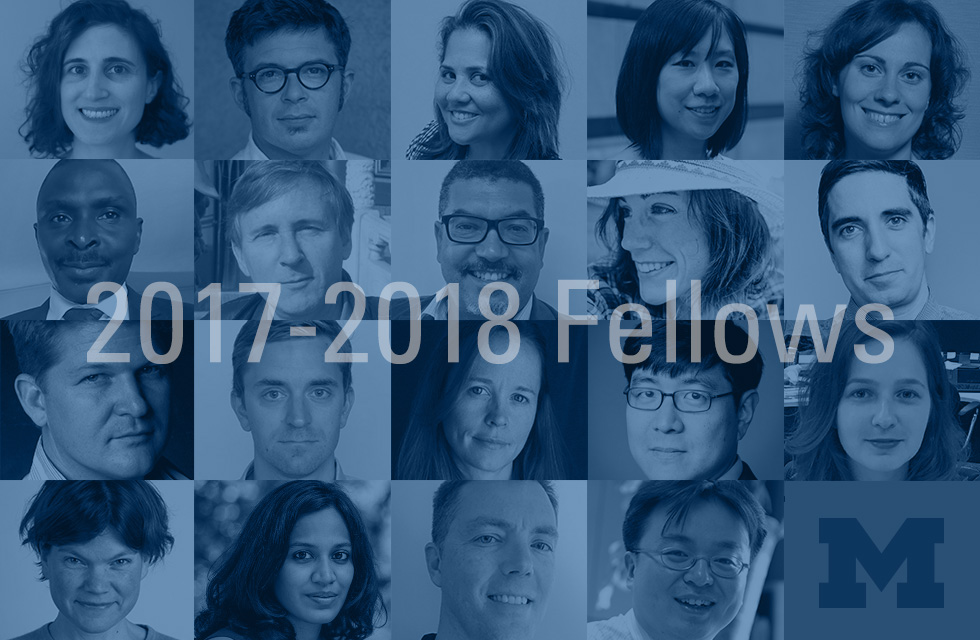
The University of Michigan has named its Knight-Wallace Journalism Fellows for the 2017-2018 academic year. The group, which includes 12 American and seven international journalists, is the 44th class of journalism fellows at the University.
“The international and domestic scope of this class of Fellows and the range of interests and expertise they bring will foster a rich environment for exploration and problem solving,” said Wallace House Director Lynette Clemetson. “Supporting the essential work of journalists is of vital importance for a democratic society. We are pleased to provide this talented group the time and resources to sharpen their craft and to develop ideas that will bolster journalism excellence and innovation.”
Knight-Wallace Fellows spend an academic year at the University of Michigan in Ann Arbor to pursue individual study plans and to engage in collaborative learning through fellowship seminars, training workshops and travel. Through twice-weekly seminars, Fellows engage with visiting journalists, eminent scholars and creative thinkers from a range of fields. Weeklong international news tours provide broader context to political, economic and social forces shaping their fields of study, and to trends and challenges facing journalism in other countries. In recent years, the program has visited South Korea, Brazil, Turkey, Argentina and Russia.
The program is based at Wallace House, a gift from the late newsman Mike Wallace and his wife, Mary. Knight-Wallace Fellows receive a stipend of $70,000 for the eight-month academic year plus full tuition and health insurance. The program is entirely funded through endowment gifts by foundations, news organizations and individuals committed to improving the quality of information reaching the public.
Fellows and their study projects are:
Dayo Aiyetan, Executive Director, International Center for Investigative Reporting (Abuja, Nigeria). Advancing best practices for whistle blowing platforms to support investigative reporting in Nigeria
Alberto Arce, Independent Journalist (Mexico City, Mexico). Understanding Central America as the world’s deadliest peacetime region
Regina Boone, Staff Photographer, Richmond Free Press (Richmond, Va.). Family, legacy and the viability of black newspapers
Candice Choi, Food Industry Writer, Associated Press (New York, N.Y.). Uncovering the social and corporate forces that shape our eating habits
Chitrangada Choudhury, Independent Journalist (Orissa, India). Local rights and the role of informed consent in ecological justice and sustainability
Danielle Dreilinger, Reporter, NOLA.com/The Times Picayune (New Orleans, La.). Race, class, gender and the present relevance of home economics class
Jennifer Guerra, Senior Reporter, Michigan Radio (Ann Arbor, Mich.). Intergroup relations: The role and responsibility of public media in fostering civil discourse
Matthew Higgins, Independent Sports Writer (Amherst, N.Y.). The interplay between soccer, status and identity among young refugees
Mark Magnier, China Economics Editor, The Wall Street Journal (Beijing, China). Anti-globalization and what it means for China’s expanding soft power
Marcelo Moreira, Chief of Special Projects, Globo TV (Rio de Janeiro, Brazil). New approaches to ending violence against journalists
Sang-hun Oh, Senior Reporter, The Korea Economic Daily (Seoul, South Korea). Pension funds and university funds: investment trends in the U.S.
Lois Parshley, Independent Writer and Photographer (Portland, Ore.). Emerging diseases and new approaches to long-form science journalism
Azi Paybarah, Senior Reporter, Politico (New York, N.Y.). Reaching beyond natural audiences: Rebuilding media credibility through technology
John Pendygraft, Staff Photographer, Tampa Bay Times (Tampa Bay, Fla.). Elevating investigative journalism projects through techniques of anthropology and feature length filmmaking
John Shields, Commissioning Editor, “Today” at BBC Radio 4 (London, England). Addressing and mitigating the loss of public trust in broadcast media
Amy Toensing, Independent Photojournalist (New Paltz, N.Y.). New ways to teach and tell stories of women through photos and documentaries
Mariana Versolato, Science and Health Editor, Folha de São Paulo (São Paulo, Brazil). New models to organize and present science and health news
Lisa Wangsness, Religion Reporter, The Boston Globe (Boston, Mass.). Emergent cultural and political issues in American Muslim communities
Robert Yoon, Director of Political Research, CNN (Washington, D.C.). Revamping how news organizations collect and disseminate election results and data
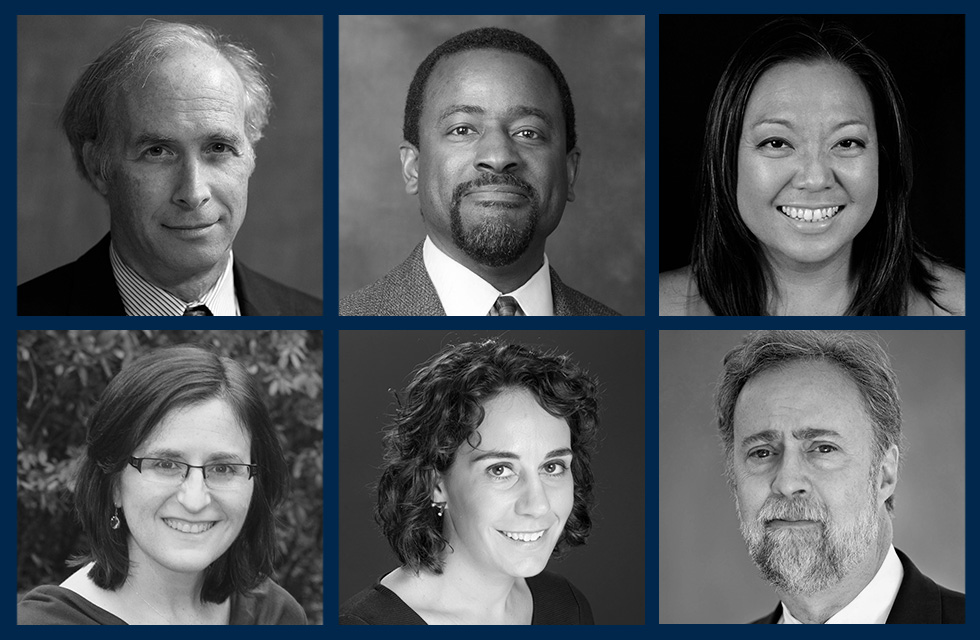
The selection committee included Wallace House Director Lynette Clemetson; Associate Director Birgit Rieck; Knight-Wallace Alumni Ford Fessenden (Graphics Editor, The New York Times), Teresa Frontado (Digital Director, WLRN, Miami), Kate Linebaugh (East Coast Bureau Chief, The Wall Street Journal), Austin Ramzy (Asia Correspondent, The New York Times) and Yvonne Simons (Assistant News Director at CBS 13, Sacramento); and University of Michigan Professors Bobbi Low (Natural Resources and Environment) and Carl Simon (Mathematics, Complex Systems and Public Policy).
A panel of Knight-Wallace Fellows and the deputy director for The International Consortium of Investigative Journalists (ICIJ) will share their stories about the biggest data leaks in history, the establishment of global networks for investigative reporters and the seismic impact of collaborative journalism.
The Eisendrath Symposium honors Charles R. Eisendrath, former director of Wallace House, and his lifelong commitment to international journalism.
It is produced with support from the John S. and James L. Knight Foundation. Michigan Radio is a co-sponsor of the event.
Will Potter, a 2016 Knight-Wallace Fellow and Marsh Professor of Journalism at the University of Michigan, will moderate the discussion.
Panelists:
Bastian Obermayer is a 2017 Knight-Wallace Fellow and deputy head of the investigative unit for Süddeutsche Zeitung, the largest national daily newspaper in Germany. He is the reporter initially contacted by the anonymous source of The Panama Papers. Obermayer is also the author of several books, the most recent of which is the story of The Panama Papers.
Marina Walker Guevara is the deputy director of The International Consortium of Investigative Journalists (ICIJ). A native of Argentina, she has reported from a half-dozen countries and her investigations have won more than 25 national and international awards. Walker Guevara managed some of journalism’s most consequential investigations on global corruption including The Panama Papers, which involved more than 370 reporters from 107 media organizations in 76 countries. Other investigations include Swiss Leaks, Luxembourg Leaks and Offshore Leaks.
Edouard Perrin was a 2016 Knight-Wallace Fellow and is a documentary investigative reporter for Premières Lignes Télévision in Paris. He is the reporter who revealed Luxembourg’s secret tax deals with major international corporations in 2012, the story that morphed into Luxembourg Leaks. He produced two documentaries on the topic, earning him several awards and a criminal indictment in Luxembourg. Acquitted in June 2016, Luxembourg appealed the initial decision and retried Perrin in December 2016. A new verdict is expected on March 15, 2017.
Laurent Richard is a 2017 Knight-Wallace Fellow, investigative journalist and editor-in-chief of Premières Lignes, a television production and news agency based in Paris. He oversaw Premières Lignes Télévision’s coverage of the Luxembourg Leaks in 2014. Richard is currently developing a collaborative journalism network devoted to publishing the work of reporters who are threatened, jailed or killed.
Michigan Radio is a co-sponsor of the event.
About the John S. and James L. Knight Foundation
Knight Foundation is a national foundation with strong local roots. We invest in journalism, in the arts, and in the success of cities where brothers John S. and James L. Knight once published newspapers. Our goal is to foster informed and engaged communities, which we believe are essential for a healthy democracy. For more, visit knightfoundation.org.
We at Wallace House, home of the Knight-Wallace Fellowships for Journalists and the Livingston Awards, remain steadfast in support of our international Fellows and of the alumni and community who make our programs stronger. Welcoming international Fellows to Wallace House for an academic year of research and study at University of Michigan is central to our work, our mission and our values.
As we proceed through application season for our 2017-18 Fellows, we will continue to follow closely changes to U.S. policy and practices on immigration. Political decisions regarding immigration policy will not affect our evaluation or acceptance of applicants.
Wallace House exists to support the work and development of journalists. In doing so, we support the essential work of journalism to inform and engage the public, to pursue and present verifiable facts and complex truths and to hold the powerful to account. Welcoming international journalists enriches our mission. We will not shut our mouths. And we will not restrict our welcome.
Lynette Clemetson, The Charles R. Eisendrath Director of Wallace House Knight-Wallace Fellowships for Journalists and the Livingston Awards University of Michigan
A panel of national journalists and a political science expert will offer analysis about the presidential election and the tempestuous aftermath during a public discussion at the University of Michigan.
The focus will be on criticism of the media, what journalists, pollsters and political experts missed, and the path forward in covering an unprecedented presidency and divided country.
Lynette Clemetson, director of Wallace House at U-M, said it is important to hear from reporters who have covered the presidential election from the beginning.
“It is even more important to turn our attention to what comes next,” Clemetson said. “We are entering uncharted waters. As much as news organizations need to to examine their coverage priorities, news consumers need to become astute in assessing the flood of information coming at them and the role and function of a free press in society.”
The panel includes alumni of the U-M Knight-Wallace Fellowships for Journalists who covered the campaign and will report on the transition, as well as a former Livingston Awards winner and a U-M expert who follows elections and voting behavior.
Panelists:
● Craig Gilbert is the Milwaukee Journal Sentinel’s Washington bureau chief and author of “The Wisconsin Voter” political blog. He has covered every presidential campaign since 1988 and has written extensively about the electoral battle for the swing states of the industrial Midwest. Gilbert was a 2010 Knight-Wallace Fellow.
● Vincent Hutchings, U-M professor of political science, is an expert on public opinion, elections and voting behavior. He studies demographic change and its effect on voting behavior and how campaign communications are designed to appeal to various group identities.
● Tracy Jan is a national political reporter who covered the campaign for The Boston Globe. She focused primarily on the GOP, including Christian evangelicals, Ted Cruz and Donald Trump. This month, she joins The Washington Post to develop a new beat on the intersection of race and the American economy. Jan was a 2015 Knight-Wallace Fellow.
● Laura Meckler is a staff writer with The Wall Street Journal where she covered the Democratic presidential primary and Hillary Clinton’s campaign. She has reported on presidential politics, the White House, changing American demographics, immigration and health care. In 1999, she received a Livingston Award for national reporting.
● Katie Zezima is a political reporter for The Washington Post where she covered the Obama White House years. She chronicled the campaigns of Kentucky Senator Rand Paul and Texas Senator Ted Cruz from start to finish and before switching to enterprise reporting on social issues riling the election in its final months. Zezima was a 2012 Knight-Wallace Fellow.
Jon Morgan, an editor in the Washington bureau of Bloomberg News since 2010, will serve as moderator. He was a 2001 Knight-Wallace Fellow.
The event is being presented by Wallace House and the College of Literature, Science and the Arts.
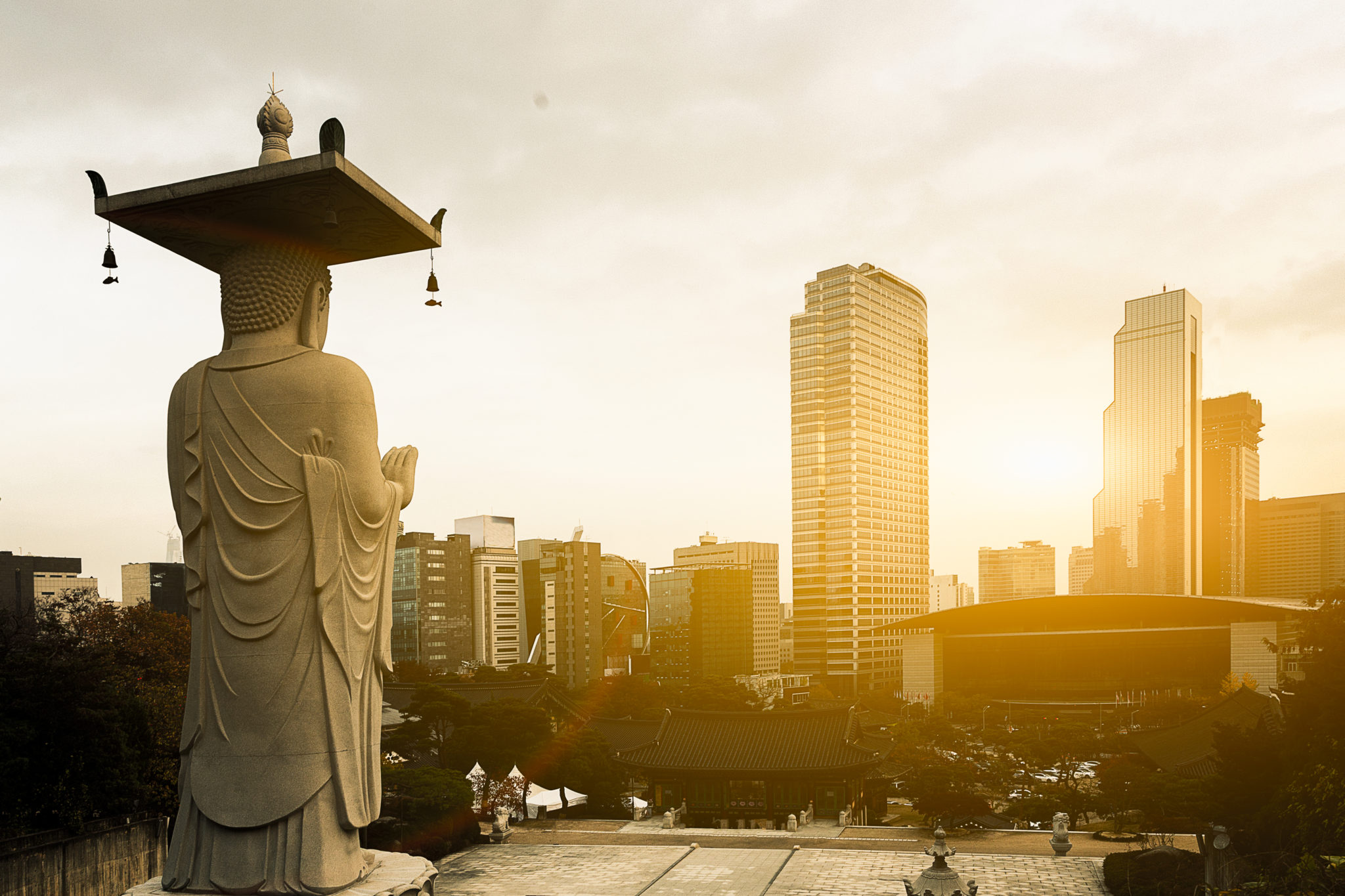
The Knight-Wallace Fellows will travel to Asia for the first time since expanding our international news tours beyond North America in 2000. On December 10, our Fellows will board a flight to Seoul. They will gather knowledge of politics, economics and the present situation in South Korea, while also learning about culture and history.
Wallace House Director Lynette Clemetson ‘10, who worked as a foreign correspondent in Hong Kong, is pleased to take the class to Korea. “Exploring journalism, politics and culture in other parts of the world is a cornerstone of the Knight-Wallace Fellowships. I am thrilled to be expanding the program’s travel into Asia. Wallace House has welcomed so many talented journalists from South Korea to Ann Arbor over the years. How wonderful that we can now take our Fellows to Seoul to connect with our accomplished alumni network there.”
Ten classes of Fellows visited Turkey under the leadership of KWF Board Member Ferhat Boratav, editor-in-chief of CNN Turk. We were planning to go to Istanbul again this December when a new travel warning was issued in early November: The State Department ordered the departure of family members of employees posted to the U.S. Consulate General in Istanbul “based on security information indicating extremist groups [were] continuing aggressive efforts to attack U.S. citizens in areas of Istanbul where they reside or frequent.” With a heavy heart and thinking of our alumni and friends in Turkey, we decided to cancel our trip.
Clemetson talked about expanding travel to Asia from the first day she arrived in Ann Arbor. But she wasn’t expecting to do it so soon. With only five weeks to departure, a trip to Korea seemed like a difficult adventure to pull off. But after current Fellow Jin Kim helped arrange a conference call with our journalism partners at Seoul’s Press Association, the Kwanhun Club, the proposal turned into a fun and exciting proposition.
We were assured that it would be possible to put together an informative and eye-opening trip for our Fellows on short notice. Kim has been working for the past month as the liaison between our Korean partners and Wallace House. And our alumni in South Korea moved into action right away, too.
“I just moved to Seoul in April for a new adventure covering the peninsula for Stars and Stripes newspaper. I am looking forward to showing KWF ’17 my new country,” said Kim Gamel ‘15, an American foreign correspondent who spent many years in Russia and the Middle East. Gamel immediately started planning our trip to the border between the two Koreas and arranged a roundtable with U.S. military stationed in South Korea.
Jaepil Noh, KWF ’16, is working tirelessly behind the scenes to schedule our week in Korea. He is trying to take the week off work to be with us. “I will show our Fellows various aspects of Korea especially focusing on its political situation. The DMZ tour will expose them to the past and the future of Korea. I will take them to historical places so they can better understand the long history of Korea. Just come and enjoy!”
Our schedule now resembles a typical Wallace House news tour:
Seminars about policy, politics and economics in Seoul
Dinner with Fellowship alumni and foreign correspondents
Seminar with Newstapa (the Korea Center for Investigative Journalism partnered with current Fellow Bastian Obermayer for The Panama Papers)
Tour and seminar at Samsung
Trip by express train to Gyeonju, the capital of the ancient kingdom of Silla
Travel to the DMZ, the Korean Demilitarized Zone between North and South Korea
And of course, we are keeping with our news tour traditions of going to places at the most interesting time:
Since changing our plane tickets from Istanbul to Seoul, the protests calling for the Korean President Park Geunhye to resign have grown. In the past, Fellows have experienced protests in Argentina, Brazil and Turkey. They saw the Canadian oil production tank in Alberta.
Now we will arrive in South Korea in the middle of a fascinating political crisis.
“So I plan to take you to the square where Korean people gather on Saturdays to demand that the President steps down,” said Noh. “The demonstrations are peaceful and people are enjoying them as if they were a festival. If you see them, you will see how humorous and witty and great the Korean people are.”
We are curious and excited to discover Korea, and very thankful for all the help our partners and alumni are giving us.
Applications are open for the 2017-18 Knight-Wallace Fellowships for Journalists, and there has never been a better time to apply. We are adapting how the fellowship works, infusing new ideas into some of the longstanding qualities that have made our program unique. And we are expanding our connections to the larger journalism world, ensuring that our programs and activities are responsive to the changing needs of news organizations and to the needs of journalists who want to build new and deeper skills.
Our goal at Wallace House is simple. We seek to sustain and enrich journalism by sustaining and enriching journalists. We believe that there is a tangible benefit to stepping away from the grind for a period of focused study and collaborative sharing of expertise. And we know that benefit extends far beyond the individual journalists chosen as Fellows. It flows back into the news organizations and broad networks from which our Fellows come.
If you’ve seen images of Wallace House, you may have felt the pull of its quaint, Craftsman charm. It is true; we have a uniquely warm and welcoming home base. But the best part of what happens here is the mischief and boundless possibility we foster inside our walls. Journalists can be creatures of habit. So our program is intentionally structured to shake up routines to challenge assumptions and to nudge people out of professional and personal ruts. We seek to unsettle, and in doing so to empower our Fellows to envision new applications for their talents.
How does it all work? Our magic happens through a mix of academic immersion, Fellowship seminars, adventurous travel and good old-fashioned down time and bonding. An average week could include:
An entrepreneurship class with MBA students in the Zell Lurie Institute in the Ross School of Business
A course in screenwriting, environmental justice or the history of Hip-Hop music and culture
A private workshop on encryption with experts from the School of Information
A storytelling seminar with a visiting journalism leader from Vox Media, The New York Times or NPR
A family-style dinner for 25 featuring Caribbean rice and peas, Southwestern root vegetable enchiladas or German sauerkraut and beef, all prepared in the Wallace House kitchen by your fellow Fellows.
And that is an average week on campus. On our travel weeks, we work to extend that same dynamic mix of intellectual stimulation to group trips outside of Ann Arbor. We may be exploring the burgeoning business, arts and culture scene in Detroit, or picking apples and hiking in Northern Michigan. In this 2016-17 academic year we are taking our Fellows to South Korea and Brazil where we will meet with journalists, political leaders, business executives, academic experts and cultural influencers.
If it sounds fun, it is! But don’t be fooled into thinking of it as “time off.” Yes, it is time away from your day job. But our schedule and expectations are rigorous. Fellows often find themselves overwhelmed by our plentiful offerings and exhausted by the syncopated rhythm of the days. There is a method to our approach. We believe you can absolutely hit upon a career changing idea working with a preeminent environmental scholar at the Graham Sustainability Institute. But we also believe your ah-ha moment might come while sledding down a bodacious hill with your kids in the depths of a Midwestern February, by meeting a K-Pop impresario in Seoul, or by exploring a contemporary art museum in the Brazilian rainforest.
We believe that awakening the mind and the senses produces sharper, more engaged journalists, and that sharper, more engaged journalists produce better journalism. It’s not rocket science…though our Fellows have access to plenty of those, too, through the university’s world class Aerospace Engineering Department.
Who are we looking for? Fellowship classes — like news organizations — are at their best when they contain a vibrant mix of backgrounds. Our program is designed to help Fellows learn from one another as much as from the academic and journalism experts who work with us. That means we’d like our applicant pool to include: daily reporters and bloggers; narrative and investigative reporters; web, video, audio and social media producers and editors; broadcasters and podcasters; visual and data specialists; designers and developers; engagement editors; and entrepreneurial project and product visionaries. We’re a mid-career fellowship, so you need at least five years of experience working for news organizations or as a freelancer.
If you’ve been thinking of applying, now is the time to do it. Take it seriously. We know you are journalists, and you are hard-wired to procrastinate until painfully close to our deadlines. Our international application period closed on December 1. For U.S. applicants, the deadline is February 1. Don’t wait too long. We only take a small number of Fellows each year, and the process is highly competitive.
Do your reporting. Talk to former Fellows and get working on your study plan. If you can, talk with your editor or manager about a project you could pursue that would benefit your newsroom or help your organization address a pressing challenge.
Don’t fall back on clichés and what you think the selection committee will like. Take some time to really think about your passions, your skills, and something you’d like to achieve in your career. We are enthusiastic about the role our program has to play in the future of journalism, and we are looking for people who want to get their hands in the clay.
There is no place quite like Wallace House and no program quite like the Knight-Wallace Fellowships for Journalists.
Molly Ball ’10, has emerged as one of the most prominent political reporters of the 2016 election season. As a staff writer for The Atlantic, her unsparing analysis of the campaigns, keen observations of society and dry wit have made her a must-read for political junkies. They’ve also made her a favorite of cable news programs and Sunday morning political shows. In addition to following her richly textured stories from around the country and her quick takes on the news of the day, Ball’s tens of thousands of social media followers also delight in her frequent selfie posts, where she makes fun of her glamorous TV makeup then notes that it is time, once again, to “Face the Nation.”
And yet, Ball didn’t grow up watching “Face the Nation,” or any of the other political shows on which she is now a regular. Her family didn’t own a TV.
I asked her about that, as well as a few other things, when she visited Wallace House in September to deliver the 31st annual Graham Hovey Lecture. Her topic, of course: Election 2016 – The Great Disruption of American Politics.
Lynette Clemetson: Many people feel they are getting to know you this election cycle through your television appearances, as much as through your writing. And yet you have a very distant relationship with TV. What’s the importance of television for you as a journalist?
Molly Ball: My parents are retired college professors. My mother felt very strongly that television rots children’s brains. So I was the freak in school who didn’t know what any of the television shows were. The downside of that is that to this day I am culturally illiterate. I’ve never seen an episode of “Happy Days” or “Saved by the Bell.” But the upside is that my consciousness of stories and of narrative was formed by reading books.
Television is not my job. I don’t get paid for it. I just want to have interesting conversations with people. I’m just trying to get my head around what’s happening in this country. America is a puzzle that I’m always trying to solve. I do that by flying around the country and talking to people and seeing things happen, by being a witness to events and then trying to tell that story to other people in a way that makes them think or sheds light on things. The medium really doesn’t matter when that’s what you’re trying to achieve. It can be Twitter, it can be TheAtlantic.com, it can be “Meet the Press” or it can be an article in a print magazine. Which does still exist.
Clemetson: Speaking of print, you have different audiences with different habits there, too. Do you approach the print and digital versions of The Atlantic differently?
Ball: I think I write in the same voice in both publications. What I love about The Atlantic is that since it was founded in the 1850s, it’s been the magazine of the American idea. I like stories that are about ideas, not just about personalities or events. Not “This happened and that happened,” but “What does it mean? Why is it happening? What’s the context, the history, and what does it tell us about the bigger picture?”
Inside The Atlantic, we refer to things as “Atlantic-y.” You know it when you see it. It’s that combination of smart and fun, high and low, in a way that is both enlightening and shareable, which has the great virtue of working really well in our current online marketplace. It doesn’t matter if the thing is a listicle or a photo meme or a 300-word blog post or a 3,000-word story. It’s just about having that sensibility.
Clemetson: How did the Knight-Wallace Fellowship help shape your career?
Ball: The fellowship changed my life. I was stuck. Stuck in a newspaper business that no longer had any sort of upward mobility, at least not for me. I had been banging my head against the wall trying to move up for so long. I thought maybe I should take the hint the world was trying to give me and just get out of journalism altogether, which would have been both heartbreaking and difficult, since I didn’t know how to do anything else. This has been the only thing I knew how to do since I was 12 years old and started a newspaper in my neighborhood in Colorado.
The journalism business had been saying no to me for years and years. And suddenly, at Wallace House, I was in this place where the answer to everything was yes. And it absolutely restored my soul and showed me there was a path forward in journalism.
Clemetson: Was that path immediately clear for you?
Ball: I still didn’t know what that path was when I left the fellowship. Nine months after I left Las Vegas and moved to Ann Arbor, I still didn’t have a job anywhere. But the fellowship restored my sense of possibility and my confidence that I belonged.
My husband and I moved to Washington, D.C., in June 2010 with no jobs, an infant, and a small amount of savings. Politico hired me in late September. I was dying to cover the midterms because I knew the Harry Reid race backwards and forwards. The Atlantic hired me a year later.
Clemetson: Has this election cycle revealed anything to you about yourself as a writer, and as an observer of people?
Ball: There have been times in this campaign when I’ve actually felt that my reporting skills were atrophying because to write an amazing story about what’s happening right now in American politics you don’t need any kind of clever angle. All you have to do is point and go, “Holy crap, look at this.” But it’s a great story. And I feel like I’m learning a lot about America – not all of it happy. Those are the best stories, the ones that make you rethink your assumptions and question all you thought you knew about how this thing works. And having the tools and the confidence and the support to just go out and tell the story the way it needs to be told is an incredible privilege at a time like this.
Clemetson: Campaigns can make journalists cynical. You actually seem excited.
Ball: I’m more excited about journalism than I’ve been in a long time because the election is such a great story. There’s so much texture to it. There will be so many aftershocks. There are so many strands to pull out and explore. And they are going to last for so long after this election.
Four years ago, I was trying to find interesting angles on Mitt Romney, which was sometimes a challenge. I was looking ahead to the rest of my career, thinking, “Am I just going to be writing the same stories every four years until I die?”
But no, because it turns out this thing is always changing. And that’s really exciting and cool. The story most people want to read about an election is who’s going to win. But most of the time that’s the least interesting story. The more interesting story is what is happening out there in America. Who are these voters? What are they thinking? What does it reveal about our national character and society? And the extent of the disruption in this campaign makes me think that we are really at a turning point in American political history, and I don’t think any of us know where it’s going to end.
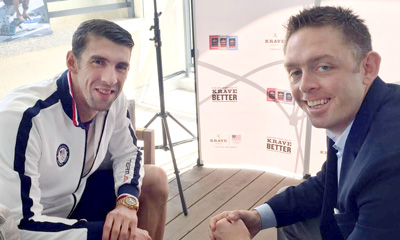
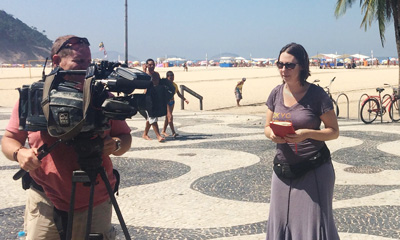
Six Knight-Wallace alumni share with us their own gold, silver and bronze moments covering Rio 2016.
Linda Robertson ‘07
Wayne Drehs ‘10
Sarah E.T. Robbins ‘12
Marcelo Barreto ‘99
Vahe Gregorian ‘04
Baris Kuyucu ‘07
Linda Robertson ’07
Sports Columnist, The Miami Herald
Gold
The Olympics have become so commercialized, bloated and pre-packaged for TV, that the soul of the Games gets lost among the VIPs. One of the highlights for me was reporting from inside Rio’s favelas, home to one third of the population in a city where extreme poverty is juxtaposed with extreme wealth. I watched the opening ceremony at an outdoor pub in Chapeu Mangueira, where residents expressed more enthusiasm for the Games than well-to-do cariocas. I wrote a story on Brazilian athletes who grew up in favelas and, with the help of some teenage street vendors, tracked down the childhood home of a judo gold medalist, Rafaela Silva, in the notorious City of God, where my driver had to declare solidarity with the drug gang that oversees the favela so he wouldn’t be harassed or shot. Silva’s relatives then took us around the neighborhood carrying a poster of her, and their friends offered us grilled kabobs while proudly posing for photos with the poster.
Silver
The media’s depiction of Rio was distorted even before the Games when certain outlets fanned panic about the Zika virus, which helped scare a few golfers away – or enabled them to use Zika as an excuse for not competing. Fear of terrorism has become de rigueur, as we saw before the Athens Olympics, when we were issued gas masks, and the Sochi Olympics, when a Chechen “Black Widow” had supposedly breached the security wall. Yes, Rio is a troubled, polluted city and no, it wasn’t ready for the Games, but things came together adequately. Press coverage became less sensational and more accurate as the Games progressed, even to the point that U.S. swimmer Ryan Lochte was roundly criticized for exploiting Rio’s crime-ridden image to turn a drunken episode at a gas station into an armed robbery yarn. After three weeks, I had zero mosquito bites, only to return to Zika hysteria in Miami.
Bronze
Had Dante created another circle of Hell, he might have called it the Mixed Zone. This is the area athletes pass through once they leave the field of play to meet the press, where we actually get to speak to Michael Phelps, Simone Biles and Usain Bolt. It’s a gauntlet of TV cameras first, followed by print media. For reporters, the Mixed Zone is akin to a rugby scrum. Lots of jostling and grappling to get in position to ask or shout a question to Neymar or Farah, or to hear the often unenlightening, unquotable answers. In Rio, there was some use of risers and microphones for athletes – which we’ve requested for years so your head doesn’t wind up in another reporter’s armpit and your ribs don’t get bruised by elbows – but alas, it remains an uncivilized way to conduct interviews. For the record, the magnetic Bolt consistently gives the best answers.
(Linda Robertson, sports columnist at The Miami Herald, covered her 13th Olympics, with Lillehammer still ranked Number 1, and Atlanta remaining in last place.)
Wayne Drehs ’10
Senior Feature Writer, ESPN The Magazine and ESPN.com
Gold
In 16 years of working at ESPN, I’ve never interviewed an athlete more gutted after a defeat than defending Olympic wrestling champion Jordan Burroughs. Rio was supposed to be the Games that catapulted Burroughs to the level of a Michael Phelps or Simone Biles. Instead, he put everything he had into his training and preparation and didn’t even reach the podium. Afterwards, he had every reason to walk past reporters and decline their interview requests. But instead, Burroughs stood there for a good 10 minutes, tears streaming down his cheeks, answering question after question after question, trying to put into words what it felt like to know that he had failed to reach his Olympic goals. His first two words: “I’m sorry.”
Silver
Perhaps no moment of the last year better revealed the transformation that Michael Phelps has undergone outside the water than the fact that he wasn’t with teammate Ryan Lochte on the night of Lochte’s gas station adventure. Four years earlier, Phelps admits, he would have been there. But instead, when Phelps checked out of the Olympic Village late that night, he headed to a hotel where he was fast asleep with his fiancée, Nicole Johnson, and their three-month-old son, Boomer, while Lochte and three other U.S. swimmers were out on the town. “And there was nowhere else I wanted to be,” Phelps said.
Bronze
The fact that a country with a struggling economy and soon-to-be-impeached president could pull off the Olympics without any major catastrophes proves, in many ways, how indestructible the Games truly are. Government corruption, human rights abuses, polluted water, escalating violence – none of it matters. The show must go on. In the end, that’s what the Olympics are – a global reality show. The host city provides the backdrop, consequences be damned. Ultimately, Rio’s legacy in the months and years to come will likely be to reveal how much this needs to change. The question is whether or not anyone will care to listen.
Sarah E.T. Robbins ’12
Senior Producer, BBC News
Gold
“Brazil is not for beginners,” they say. The best coverage of the big picture during the Olympics came from journalists who have spent significant time in the region. The South American bureaus of the BBC, The New York Times, and NPR produced crucial reports examining how Rio organizers missed the opportunity to improve the city for all of it’s residents and accounts on the rise in violence in Rio’s poorest neighborhoods, even as the military secured tourist areas.
Silver
Sports reporters have to tighten the screw at the right moment, and sports news isn’t always about sports – although there were plenty of great sporting moments at the Rio Games. Key stories about Rio’s doping lab, an alleged ticket-touting scheme and a deep investigation into the Lochte story uncovered important details that many journalists missed.
Bronze
After Usain Bolt won the 100-meter dash, a photographer told me that he usually shoots fashion in Finland and was “surprised by all the elbows” from colleagues seeking to capture an iconic image of the World’s Fastest Man. Potential lesson for covering future mega-events: send news junkies.
Marcelo Barreto ’99
Chief Editor and Anchor, SporTV News (Brazil)
Gold
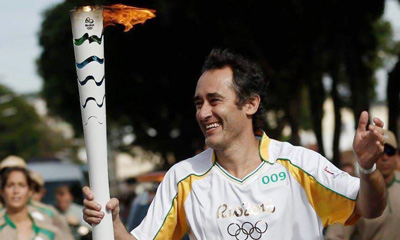
Carrying the Olympic torch. I always dreamed of doing it, but could never have imagined it would be like that: in my little hometown, Bicas, surrounded by family and friends. An unforgettable day!
Silver
Sharing the Olympic experience with family and friends. I was living in London during the 2012 Games and attended a few events with my wife and kids, but this time was special. I was almost never alone at the Olympic Park.
Bronze
Interviewing Feyisa Lilesa. The Ethiopian marathoner was hiding in Rio after making a protest gesture against his country’s government at the finish line. I was the first reporter to talk to him.
Vahe Gregorian ’04
Sports Columnist, The Kansas City Star
Gold
With the ocean shimmering in the background and thousands shimmying within the venue, the nighttime atmosphere of beach volleyball at Copacabana was the essence of the promise of the Rio Olympics. The scene was an intoxicating reprieve from a series of logistical glitches that threatened to derail the Games – and a snapshot that will remain indelible even as we come to see the consequences of an emerging country in economic crisis hosting an event that has become too enormous for even the most modernized nations to manage.
Silver
The Olympics are an exhilarating, out-of-body experience for reporters to cover and one of the ultimate challenges in the business. I’ll be forever grateful to have had the privilege of attending 10 of them. It’s amazing to bear witness to people shattering the limits of what we think possible – lifting us all “to a better place to be,” as it’s put in one of my favorite movies, “Vision Quest.” But my favorite part of the Games has always been writing about local athletes, people you have the opportunity to really get to know and thus absorb the experience in an entirely different way – and, hopefully, convey.
So I expect what I’ll remember most about Rio was following wrestler J’den Cox of Columbia, Missouri, and his family after he won a bronze medal in dramatic fashion, and watching archery with Robin Garrett, whose son, Zach, won a silver medal in the team event. Zach fulfilled a dream that began when he was four years old on the family farm in Wellington, Missouri, when his father carved him a bow.
Bronze
We in the media often report what could go wrong or might happen. Rio was projected as an impending apocalypse because of the spike in crime in the wake of Brazil’s economic meltdown. Sure, a vast police and military presence made it safer, but we failed to portray the hazards as being similar to any big city: some areas should be avoided, one should generally be alert, etc. Violent crime was improbable in popular areas, yet unnecessary fear kept many, including families of athletes, away. That was a shame.
Baris Kuyucu ‘07
Head of International Sports, Anadolu Ajansi (Istanbul)
Gold
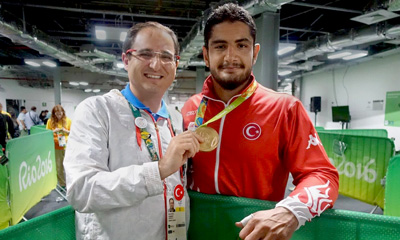
I watched every medal moment of our Turkish team – emotions, pride, excitement. I interviewed all of them. One highlight was spending time with the gold medalist wrestler, Taha Akgul, an exceptionally talented and passionate guy. I spoke with him and his lovely family just before he competed. After his gold-winning moment, we just hugged each other – nothing more needed to be said. It was unforgettable!
Silver
Thanks to a previous visit with Knight-Wallace colleagues, I know Rio very well. That is why I was so comfortable there as a journalist. Twenty-one days of working nearly 16 hours a day was tough. I organized every detail of my teams’ program. But it was a nice experience. I met so many wonderful Brazilian people and fellow Knight-Wallace journalists, Vahe (Gregorian ’04) and Linda (Robertson ’07). I am always so proud of being a Knight-Wallace Fellow. Go Blue!
Bronze
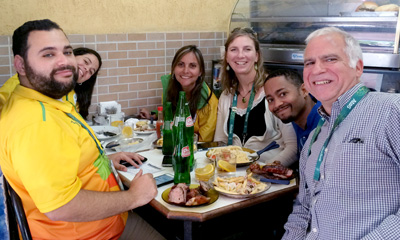
Each day, I had only one or two hours of free time, except for five hours of sleep. So I walked every minute, got acquainted with the locals, tasted Brazilian foods, took many pictures, and hung out for midnight dinners with my team and new friends. We talked and shared so many things. This was the first time I reported from the Olympics. It was not easy, but it was so much fun. Rio rocks.