Reflections from Washington D.C.
A Clear Mission, a Touch of Envy

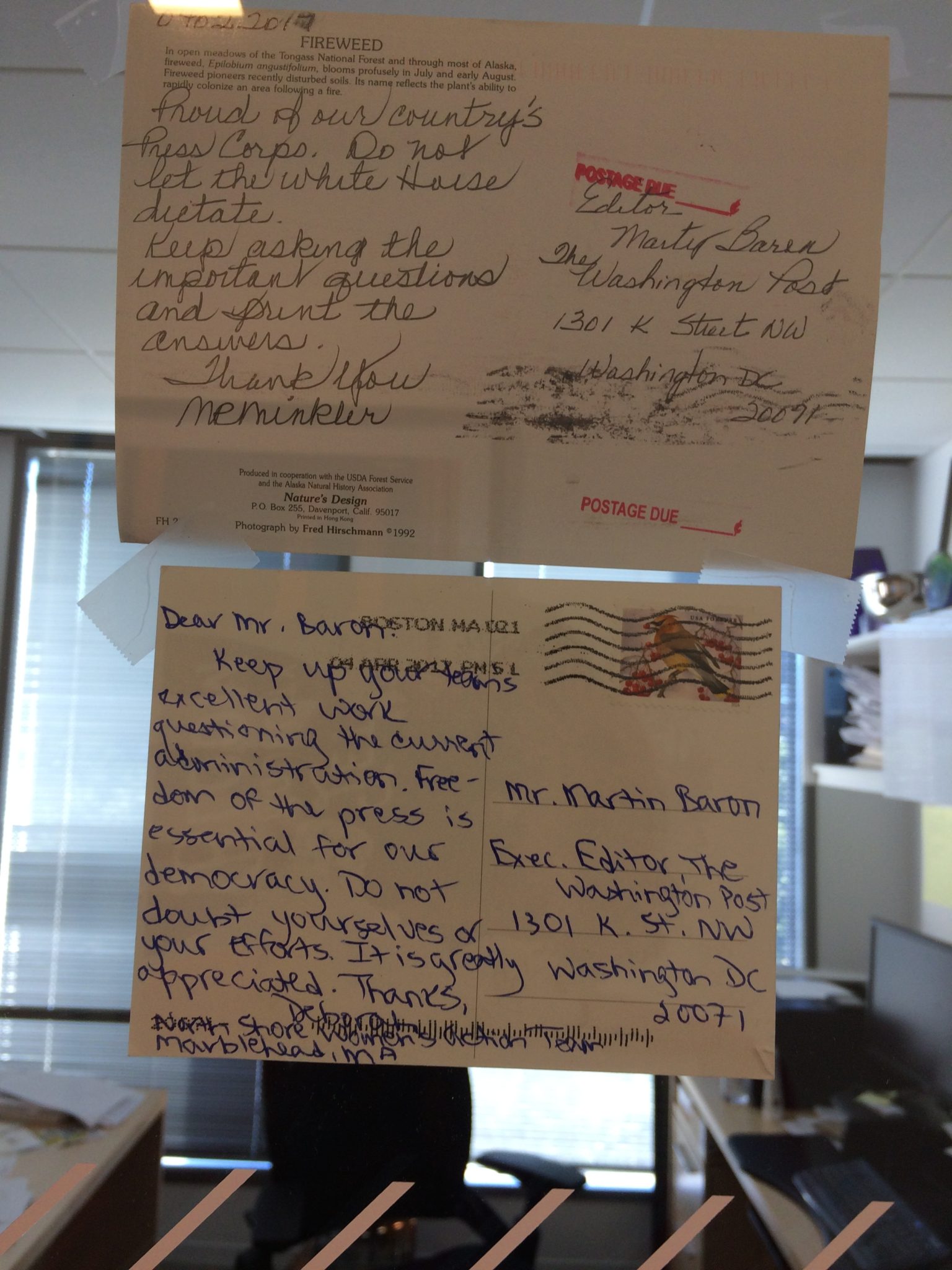
Letters from grateful readers addressed to
The Washington Post executive editor, Marty Baron, hang on his office walls.

On a warm October afternoon, as Marty Baron, the venerated editor of The Washington Post, spoke with our fellowship class, I felt admiration, and envy.

Baron outlined how his legacy newsroom was embracing technological changes and had garnered over a million digital-only subscribers earlier this year. The paper’s willingness to adapt, he stressed, was underpinned by its foundational mission of striving for the truth.

Over the past year, The Post has published an impressive stream of stories investigating President Donald Trump’s election campaign, his family members, his business interests and his administration. Earlier that afternoon, as we toured the Post’s newsroom, the outer glass walls of Baron’s office, plastered with grateful letters from readers, captivated me. One note read, “Dear Mr Baron, [… ] Without the hard work of your reporters, our situation today would be so much more dire.” Another said, “Keep asking the important questions. And print the answers.”

Later, as Baron spoke to us, I wondered if in India, an editor like him could survive the political and economic powers that stifle journalism’s core function – “ask the important questions, print the answers.”

Like President Trump, India’s Prime Minister Narendra Modi loathes the press. Unlike Trump, Modi chooses complete disengagement. He has not held a single press conference in 40 months of holding office. A senior minister in his cabinet coined the term “presstitutes” for journalists asking inconvenient questions. Most legacy newsrooms in India are fearful and self-censor. Last month, the exit of the editor-in-chief of The Hindustan Times, my former newspaper and a leading national daily, was preceded by a meeting between Modi and the paper’s proprietor. The editor lasted in the job for little over a year. Among the paper’s projects, which reportedly upset the government, was “Hate Tracker” – a digital database documenting India’s rising hate[A1]  crimes, including the lynching of religious minorities.

Newsrooms – mostly small, alternative media, and nascent, digital outlets – that are putting up a fight are especially under threat. On October 5, while we were in D.C., Gauri Lankesh, a Bangalore-based editor of a small newspaper, was posthumously given the Anna Politkovskaya Award, established in memory of the slain Russian journalist to honor a female human rights defender. A month ago, assailants had fatally shot Lankesh outside her home as she returned from work.

The day our trip ended, The Wire, a fledgling, resource-strapped website in India, reported how the turnover of a firm headed by Jay Amit Shah, the son of the President of the ruling Bharatiya Janata Party (BJP), had increased 16,000 times over since the BJP took power in 2014. The BJP and Shah did not challenge a single fact in the story. Instead, they have filed a criminal defamation suit of 100 crore Rupees (over $15 million) against The Wire’s editors and the reporter.  

I did not need dispatches from home to remind me of the powerful forces against which Indian journalists persevere. On our trip’s penultimate day, I wandered through the floors of the Newseum, lingering at the Journalists Memorial – a tribute to over 2,000 journalists, killed in the line of duty. Its centerpiece was a towering panel with hundreds of photographs of slain reporters. The collage of faces from around the world was heartbreaking, yet deeply inspiring.

In the memorial’s section titled “Stories of the Fallen – 2016”, the profiles included Karun Misra. The exhibit recorded that Misra, the 32-year-old bureau chief of a Hindi daily in north India, “had received death threats, and refused bribes, designed to deter him from reporting on illegal mining” before being gunned down last February.

I recalled a quote displayed prominently at The Washington Post newsroom: “There is only one good reason to enter journalism. When we do our job, we can make a difference.” The fellowship trip was a powerful reminder of why we must persist.

Chitrangada Choudhury is a 2018 Knight-Wallace Fellow and an independent multimedia journalist based in the eastern Indian state of Orissa.
Reflections from Washington D.C.
No Simple Answers


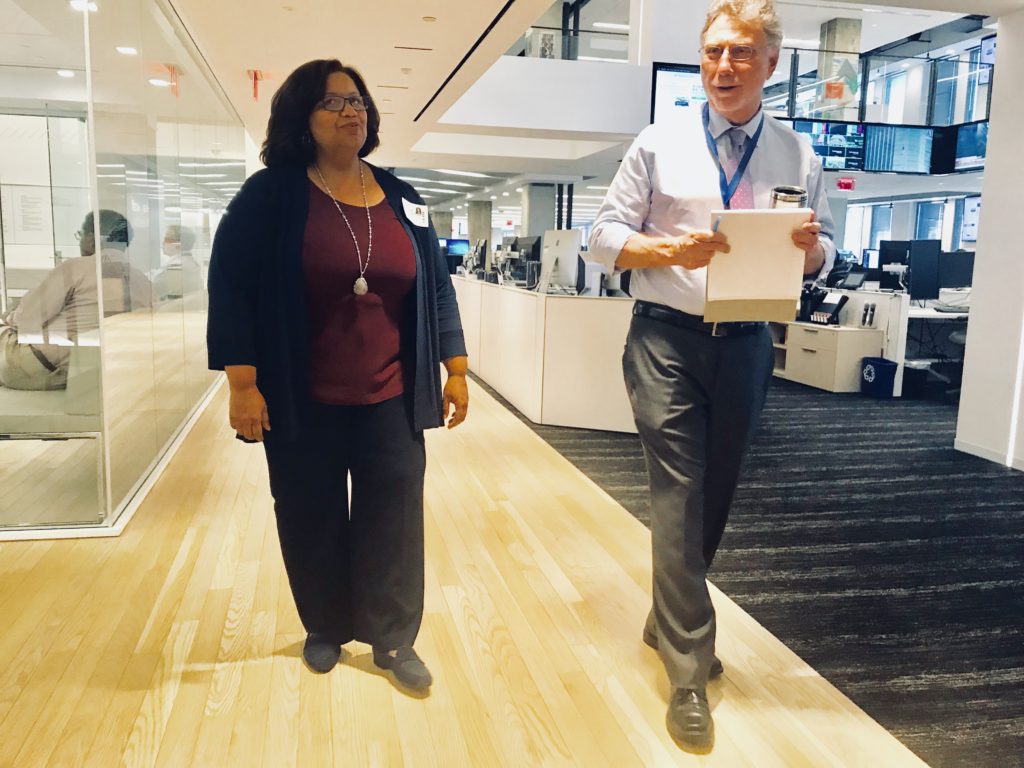
Marty Baron, pictured with Director Lynette Clemetson, was
generous with his time and gave a seminar for the Fellows during
their visit to The Washington Post.

Walking down the street on my way to the Online News Association’s annual conference at the Marriott Wardman Park hotel in Washington, D.C., a recognizable man with short gray hair and neon shorts ran past me. He looked like John Podesta.

If it was Podesta, it made sense that he would be running away from wherever reporters were gathering. As manager of Hillary Clinton’s 2016 presidential campaign, Podesta led the post-election hand wringing about Russians stealing his emails, media fascination with the email saga and the need for a more intelligent way to report on politics. Broadly, I agreed with him. That’s why, after 14 years covering politics in New York City, with a popular newsletter under my belt and enough appearances on cable news shows to justify carrying a blazer and tie in my backpack, I decided to apply for a Knight-Wallace Fellowship.

I was so steeped in daily political coverage that when I heard my class of Fellows was coming to D.C., it seemed incomprehensible that we would do anything other than talk about the 2016 presidential election the entire time. I was surprised when the conversations unfolded differently.

Our group met with Marty Baron, executive editor of The Washington Post, and top editors at NPR and The Atlantic. All were adapting a digital-dominant approach to news and figuring out how to deliver more content to their core constituencies and paying customers. I wondered about the unseen costs of this faster, customer-focused approach.

I hoped to get answers at the conference. When ONA started in 1999, it was like a support group. Digital reporters were interlopers in the newsroom, afterthoughts sitting at the kids’ table, far away from the adults. Today, across the street from the conference hotel, an old Washington Post newspaper box sat empty, spray-painted black and locked. The conference, by contrast, was crammed with over 3,000 digitally-focused attendees. Surely this would be the place to offer direction on the issues nagging at me. How should we use the internet to better cover politics? How are smart reporters using Facebook and Twitter? Can I make a podcast about politics as popular as a cat video?

There was plenty on offer about the latest digital trends. Left hanging, though, remained the thorniest questions raised by the 2016 presidential election. For instance, can reporters clustered on the East Coast reliably cover Red State America? This topic was front and center in ONA’s first session, led by CNN’s Brian Stelter: “Trust, Truth and Questions for the Media.” Panelist Nikole Hannah-Jones, a staff writer for The New York Times Magazine, said the public is losing trust in the media because newsrooms aren’t diverse enough. Cenk Uygur, co-founder and host of The Young Turks, said it was less about race and more about poverty, an issue “corporate media” and well-paid reporters are not good at covering.

Both of those seemed correct, and yet, incomplete. I found myself nodding along when public radio reporter Asma Khalid said the primary problem was a dearth of reporters in the majority of American communities. She noted a disturbing trend during the presidential race. Reporters – often from the East or West Coasts – tracked down voters – often in the middle of the country – grabbed their quotes, then left. Practically nobody stuck around, let alone made return trips. Khalid did. “I never thought I’d see you again,” one voter told her. The anecdote reminded me of the “left-behind” places ProPublica reporter Alec MacGillis spoke about weeks earlier at the annual Graham Hovey Lecture back in Ann Arbor.

On the final day of the conference, I entered the main ballroom minutes before the start of a session called “When Satire is the Most Effective Political Coverage.” I sat down next to a man conspicuously older than most at the convention. It was Jeff Jarvis, director of the Tow-Knight Center for Entrepreneurial Journalism and a professor at the CUNY Graduate School of Journalism. We talked about the fact that the American Society of News Editors was slated to hold their annual meeting in the same hotel a week later. The ASNE conference, Jarvis speculated, would be much smaller. He was drawing a direct correlation between conference size and industry potency.

Jarvis looked out at the amorphous ONA crowd in the ballroom – many still ambling to their seats with tote bags full of CNN water bottles and Facebook notebooks – and said, “They don’t realize they won.”

I left Washington and ONA with more questions than answers. That’s similar to how I started my career at the Queens Tribune, often returning from press conferences with pages full of quotes and a head full of questions. Now in Ann Arbor, that confusion feels comforting. The questions wouldn’t be worth studying if the answers were easy.


Azi Paybarah is a 2018 Knight-Wallace Fellow and a senior reporter at Politico New York covering City Hall, politics, crime and the New York Police Department.

Alumni Spotlight on Tracy Jan ’15

Tracy Jan Washington Post
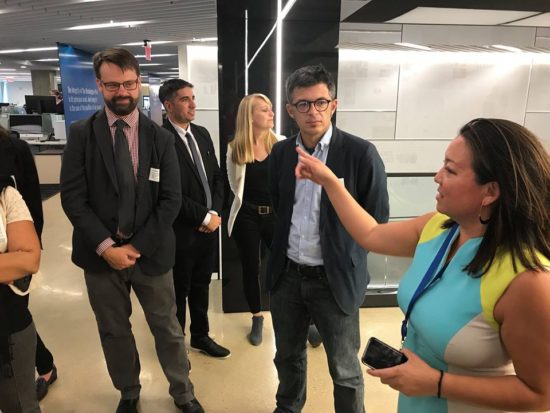
Tracy Jan ’15 provides 2018 Knight-Wallace Fellows with a behind-the-scenes
tour of The Washington Post on their fall trip to the nation’s capital.

Sitting in a hotel room watching propaganda videos from a racist hate group isn’t the way most people would spend a week in Boca Raton, Florida. But back in October 2016 issues like race, class and religion were front-and-center in a presidential campaign grinding toward its improbable conclusion.

At the time, Tracy Jan covered national politics for The Boston Globe’s Washington, D.C. bureau, a beat she’d had since 2011.

For this particular assignment, Jan spent a week in Florida writing about the growing Islamophobia that had taken root there – part of the Globe’s “America on Edge” series.

She was in her element, in a journalistic sense – even though it meant that Jan, who is Chinese American, spent her time attending hate group meetings and lunching with conspiracy theorists – all of whom were white Donald Trump supporters.

“It was cool to be able to peek into a world that was so foreign to me and write about how this hostility, fear and anger was being exploited by Trump,” Jan said over drinks this fall in downtown Washington, D.C.

When The Washington Post came calling about potential opportunities, Jan jumped at the chance to create a new beat covering the intersection of race and the economy.

As a 2015 Knight-Wallace Fellow, she studied “Morality and Money in Medicine.” In addition to covering politics, Jan was also The Globe’s national health care reporter, a role she had hoped to more fully inhabit after the 2016 campaign.

She spent her year in Michigan sitting in on confidential hospital meetings about patient care, learning about reproductive justice, medical ethics and public health. She also wrote a screenplay about Dr. Tim Johnson, chair of the U-M Health System’s Department of Obstetrics and Gynecology and his pivotal role in the national debate over an abortion procedure called “partial birth abortion” by its opponents.

But she said she came away from her fellowship year with much more than a string of story ideas, subject matter expertise and sources.

“In a larger sense, the Fellowship helped me realize that one’s ‘work’ doesn’t have to be your life,” she said. “But as journalists, we tend to make it so. So we might as well be writing about the things we care deeply about.”

Having written about health issues for several years, she felt ready for change. When The Washington Post came calling about potential opportunities, Jan jumped at the chance to create a new beat covering the intersection of race and the economy. She saw the job as a pivotal platform from which to dive more deeply into the divisions that defined the 2016 campaign and widening racial and economic inequalities.

“I like that it’s not a general ‘race’ reporting job but one grounded on the financial team, which helps me bring a bit more focus and structure to this hugely important and oftentimes unwieldy topic,” she said. “The motto here is ‘A1 or viral.’”

“I felt like I had been preparing for a job like this my entire life,” she said.

Her new beat is broad, and Jan has the freedom to choose her priorities – whether it’s a quick piece highlighting the persistent wealth gap between black and white Americans or a front page story about how Facebook disproportionately censors black activists.

“I like that it’s not a general ‘race’ reporting job but one grounded on the financial team, which helps me bring a bit more focus and structure to this hugely important and oftentimes unwieldy topic,” she said. “The motto here is ‘A1 or viral.’”

That means juggling front page or Sunday enterprise and breaking news with chattier web-only pieces to inject The Post as part of the national conversation about race.

Since the beat is new, Jan said she’s focusing on making sure that it becomes seen as an essential part of The Post’s coverage – “so eyeballs are always a consideration, as well as impact.”

Closing in on her first year on the job, Jan said she still has much to learn. She doesn’t see herself as a business “wonk.” Instead, she is focusing the sensibilities she developed covering politics and health in a new direction.

“The things I learned covering lobbying, power and influence as a political reporter should also be front and center on this beat,” she said, “because at the heart, it’s about inequality – who has and wants more, and who is left behind.”

Adam Allington is a 2012 Knight-Wallace Fellow and an environmental reporter for Bloomberg BNA

Wallace House Presents Pulitzer Prize-winning reporter David Fahrenthold

David Fahrenthold
David Fahrenthold of The Washington Post

“Trump, Twitter and Fake News: How Journalists Can Build Credibility by Opening Up Their Work” with David Fahrenthold

October 26, 2017 | 2:30 p.m. to 4 p.m.

Lydia Mendelssohn Theatre

View Video »

How should the press adapt when those in power use the epithet “fake news” to attack real reporting? Pulitzer Prize-winning reporter, David Fahrenthold of The Washington Post, offers suggestions for both reporters and news consumers on navigating this new era. He will discuss how journalists can open up their own reporting process through social media, show the public the work that underlies their stories and invite readers in as collaborators. He shares how reporters and readers can avoid passing on actual fake news, by examining the news sources and the individual stories that they read, especially those stories and sources that confirm their own views of the world.

During the 2016 presidential campaign, Fahrenthold used social media to follow-up on Donald Trump’s pledge to donate money to veterans groups. Posting his reporter’s notes on Twitter to solicit leads, Fahrenthold uncovered Trump’s questionable charitable practices and found no evidence that Trump donated money to veterans groups as he’d claimed. Fahrenthold was also the first reporter to reveal the existence of the “Access Hollywood” 2005 video in which Trump bragged about groping women. For his series of stories, Fahrenthold won the 2017 Pulitzer Prize for national reporting.

A graduate of Harvard, Fahrenthold has been at The Washington Post since 2000. There he reports on President Trump’s businesses and conflicts of interest. He previously covered the police in Washington, D.C., the environment, New England, Congress and the federal bureaucracy for the paper.

This event is co-sponsored by Communication Studies, the Department of English Language and Literature and the Gerald R. Ford School of Public Policy.

The 32nd Graham Hovey Lecture

“Piercing the Bubble: Politics, Media and America’s Prosperity Gap” with Alec MacGillis

September 14, 2017

Wallace House Gardens
620 Oxford Road, Ann Arbor

Watch the video recording.

Alec MacGillis, political reporter for ProPublica and 2011 Knight-Wallace Fellow will deliver the 32nd Graham Hovey Lecture. He will address income inequality in the U.S. and the perilous implications of winner-take-all cities and left-behind places.

His reporting and analysis of blue collar voters in the 2016 presidential election earned him the 2017 Polk Award for National Reporting and the 2017 Scripps-Howard Award.  This work included his piece, “Revenge of the Forgotten Class,” which was published the morning after the election and drove much of the post-election conversation. His recent investigation for ProPublica and The New York Times Magazine titled “Jared Kushner’s Other Real Estate Empire,” exposed the disreputable landlord practices of the president’s son-in-law and advisor.

MacGillis is also the recipient of the Toner Prize for Excellence in Political Reporting. He is the author of “The Cynic,” a biography of Senator Mitch McConnell.

MacGillis was previously a senior editor at The New Republic and a national reporter for The Washington Post. His work has appeared in The New Yorker, The Atlantic and The New York Times Magazine.

He earned a B.A. in history and English from Yale University. As a Knight-Wallace Fellow in 2010-2011, MacGillis studied income inequality. His subsequent reporting examined the culprits and costs of this issue with stories ranging from the influence of corporations on public policy to the disruption of Democratic Party strongholds.

The annual lecture recognizes a Knight-Wallace journalist whose career exemplifies the benefits of a fellowship at the University of Michigan and whose ensuing work is at the forefront of national conversation. The event is named for the late Graham Hovey, director of the fellowship program from 1980 to 1986 and a distinguished journalist for The New York Times.

Welcome remarks by Liz Barry, Special Counsel to the President.

A reception followed the lecture.

Watch the video recording.

×

Dr. Gil Omenn and Martha Darling Pledge $500,000 to the Livingston Awards Endowment


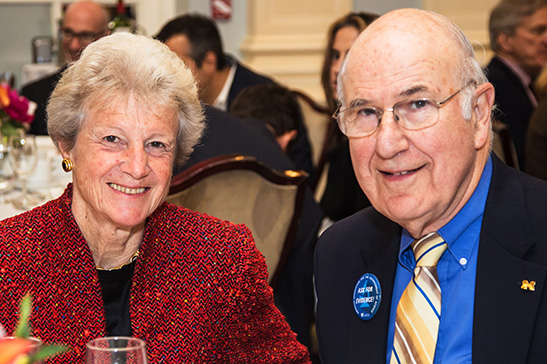
Martha Darling and Gil Omenn
Martha Darling and Gil Omenn at the Livingston Awards luncheon

University of Michigan professor Dr. Gil Omenn and his wife Martha Darling contribute to a wide range of philanthropic causes, from the fine arts to medical research to environmental conservation. This year they added Wallace House to the important institutions they support. Omenn and Darling pledged $500,000 to the Livingston Awards, a prestigious annual prize which recognizes outstanding local, national and international reporting by journalists under the age of 35.

Omenn and Darling presented their gift at the Livingston Awards luncheon on June 6 in New York City. With impassioned remarks before the 200 guests gathered for the annual event, the couple expressed admiration for the work of the journalists honored and spoke with urgency about the need to publicly support the press.

“Journalism is a bedrock activity of our society, especially in the current environment,” said Omenn in an interview this month. “This is a field where young people can make a big impact. We think it’s important, it’s underinvested, and we’re delighted to participate.”

Mollie Parnis LIvingston created the awards in 1981 in memory of her son, Robert, publisher of More, a journalism review. For more than 30 years, her family foundation offered sole support to the program, which is administered by Wallace House at the University of Michigan. The Omenn-Darling gift will go toward an endowment to secure the program into the future. They join the Indian Trail Charitable Foundation, the John S. and James L. Knight Foundation, Christiane Amanpour, and the University of Michigan among the program’s major supporters.

“This is an especially significant time to recognize and support the vital role journalism plays in our democracy,” says Lynette Clemetson, director of the Livingston Awards. “Young reporters are producing strong work across a range of storytelling forms, increasing public understanding, accountability, empathy and action around important issues. Generous gifts like this not only provide recognition to individual journalists, they also affirm the larger mission of journalism in society. We are deeply grateful.”

Omenn, director of the university’s Center for Computational Medicine & Bioinformatics and the Proteomics Alliance for Cancer Research, served as executive vice president for medical affairs and as chief executive officer of the University of Michigan Health System from 1997 to 2002. He was dean of the School of Public Health, and professor of medicine and environmental health at the University of Washington, Seattle, from 1982 to 1997. He was also associate director of the White House Office of Science and Technology Policy and the Office of Management and Budget in the Carter administration.

A noted conservationist, Darling is a member of the National Wildlife Federation’s President’s Leadership Council, which honored her contributions with its achievement award last year. Retired from a senior management position at Boeing, she has consulted on education policy for the National Academy of Sciences, and has chaired the boards of the Institute for Women’s Policy Research and the Ann Arbor Area Community Foundation.  She is also a member of the White House Commission on Presidential Scholars.

Omenn was first introduced to Wallace House and the Knight-Wallace Fellowships by former director Charles Eisendrath, who retired in 2016. Over the years Omenn particularly enjoyed his occasional visits to Wallace House to hear from guest speakers, as well as the opportunity to meet with Fellows currently in residence. Last year, Wallace House director Lynette Clemetson launched The Livingston Lectures, public events featuring Livingston winners, an initiative Omenn singled out for praise. Giving students a chance to interact with the winners demonstrates the value of having the awards’ “home base” on campus, he added.

“This is in the sweet spot for the University of Michigan — we’re all about new knowledge and developing young people,” says Omenn.

Omenn and Darling maintain other connections to the journalism world. Omenn serves on the board of directors of the Center for Public Integrity, a nonprofit investigative news organization based in Washington, D.C. He noted that CPI’s first Pulitzer Prize, in 2014, went to a 28-year-old reporter examining the systemic disenfranchisement of Appalachian coal miners with black lung disease — two-time Livingston Award finalist Chris Hamby.

And Darling is a relative of Jay Norwood “Ding” Darling, who won two Pulitzer Prizes for political cartooning — in 1923 and 1942. He went on to become founder of the National Wildlife Federation and was appointed by President Franklin Roosevelt to head the U.S. Biological Survey, a forerunner to the U.S. Fish & Wildlife Service.

Support for the Livingston Awards bolsters the work of reporters under the age of 35, creates the next generation of journalism leaders and advances civic engagement around powerful storytelling. Go to our donate page for more on how to support the essential work of journalists.

Connecting Knight-Wallace Fellows Around the World

Knight-Wallace Alumni Locator

The Knight-Wallace Fellowships has an impressive alumni network of nearly 750 journalists working around the world. The combined expertise of the group is a tremendous resource, and we want to make it easier to access. So we are adding an Alumni Locator function to our website, a simple tool that will provide the Who, What and Where of our extensive braintrust. We’re making the soft launch of the tool available now with information from recent classes, and we’re calling on alumni to help us make this a fully populated resource.

We know that part of what makes the fellowship year at the University of Michigan special is the degree to which Fellows learn from one another. We structure our program in a way that regularly brings Fellows together outside of classrooms and campus workspaces. During the academic year, Wallace House becomes a hub of activity for journalism seminars, skills workshops, meetings with special guests and public events. It is also a cherished gathering place for movie nights, Super Bowl parties, Tango lessons, cooking classes and a dizzying array of activities that knit our classes together and foster the network of professional support that makes our program so special.

Spending time together, without deadlines or structured conversations, allows Fellows to discuss their work and their journalistic methods, brainstorm their ideas and share aspirations and concerns about their future career paths. Our journalists become each other’s teachers, sounding boards and cheering squads. And the connections they form remain important when they return to their professional lives. We often get calls from Fellows asking for our help in reaching someone from another year. Sometimes it’s because they are switching beats and are in search of topical expertise. Sometimes it is because they are reporting in a part of the world they’ve never been to and they are looking for contacts and suggestions. The Alumni Locator will provide the answers through a searchable database.

Check out the Alumni Locator here. You can search for Fellows by location or subject matter.

We’ve designed this resource with multiple audiences in mind. Prospective applicants often want to reach out to former Fellows. And friends of the program often want to follow the careers of our journalists. A general view of the database allows those groups to see where our Fellows are around the world.

Knight-Wallace alumni will have password protected access that will allow them more layers of information. We’re soft-launching the tool with information provided by recent classes of Fellows.

To fully populate the database, we’ll need our alumni to provide us with the information they would like us to share. We’ll be gathering that information in the coming weeks and months, so that the tool can be fully functional by the end of the academic year.

We will have a lot of information to enter into this new database. Our hope is that by late Fall, if you need background information for a story, need to find a stringer in a new place or want to brainstorm about managing or funding a newsroom, you will be able to go to our website for quick and useful connections.

Knight-Wallace Fellows Travel to D.C.

Fellows travel to D.C.
Knight-Wallace Fellows meet with leaders in the nation’s capital and participate at ONA.

International travel has long played an important role in the Knight-Wallace Fellowships, taking the mid-career journalists in our program to places facing transformative social and political change. We’ve witnessed economic collapse, corruption scandals, public protests, government repression and tumultuous leadership shifts in countries including Argentina, Brazil, Turkey and Moscow. Last year we traveled to South Korea for the first time on the heels of massive street protests that led to a presidential impeachment.

As we started to plan travel for this year, it was impossible to escape the fact that few countries now are facing more consequential change – with more global implications – than the United States. So this October we’re heading to the most intriguing, perplexing, maddening place of the moment – Washington D.C.. We’ll hold seminars with interesting thinkers, players and influencers. And yes, we’ll request an audience with the Trump administration. Who knows whether we’ll get to Yes. But we are sure the pursuit will be interesting.

With major political shake-ups happening nearly every week, Washington also seemed to fit the running narrative of upheaval that has come to define Knight-Wallace trips. We’ve immersed our Fellows in culture, both ancient and modern, communed in the rainforest, met with scholars, court justices, political leaders, musicians and artists. But social tumult has been such a persistent backdrop of the destinations we choose, that it has become a running joke of sorts: If the Knight-Wallace Fellows are coming to your country, a coup or catastrophe may be afoot.

Washington D.C. is also the location this year for the annual Online News Association Conference from October 5 to October 7. After spending the early part of our trip in Fellows-only seminars, this year’s class will gather with hundreds of journalists and innovators around a shared commitment to advancing our industry and the technologies that support our craft. We’ll have a booth at the ONA conference to introduce new groups of journalists to the many benefits of a Knight-Wallace Fellowship. We also expect to absorb plenty of new ideas for how we can enhance our programs.

This will be a year of robust engagement for Wallace House. We’re continuing to expand our public events around the country and for the campus community. In addition to welcoming back 2011 Knight-Wallace alum Alec MacGillis for the 32nd Graham Hovey Lecture, we’ll hold public events with Pulitzer Prize winner David Fahrenthold of The Washington Post, former Livingston Award winner Lydia Polgreen of the Huffington Post and Livingston Awards national judge Bret Stephens of The New York Times.

Our globe-trotting resumes in the winter term. It’s an especially fortuitous time to have strong connections in South Korea, and we are eager to return. Last year our Fellows met with officers representing the more than 30,000 U.S. soldiers, airmen, sailors and Marines based in South Korea. We got an up close window into their “Fight Tonight” readiness if North Korea’s military provocations rose to dangerous levels. At the time, it sounded oddly hawkish, a blast from the past seemingly at odds with the relative geopolitical calm of the region. What a difference a year can make.

Whether in Washington, Seoul or on campus in Ann Arbor, we look forward to a visible and active year. At a time when the essential role of journalism is being so openly undermined, it is important to have a presence and a voice, supporting journalists and the vital work they do.

Lynette Clemetson is the Charles R. Eisendrath Director of Wallace House.

An IRE Event with 2017 Livingston Winners

Taub, Jarvis, Chavez

From the human toll of border crossings to Assad’s authorization of mass killings: Exploring Livingston Award winning stories with the Knight Foundation

June 22, 2017 | 5 – 6 p.m.
Grand Canyon 9-10, first floor
JW Marriott Desert Ridge Resort & Spa
5350 East Marriott Drive
Phoenix, Arizona


IRE conference attendees can meet the 2017 Livingston Award winners and learn how these reporters transformed their story ideas into award-winning investigations. From tracking down sources to crafting narratives, they will examine ways to dig deeper and tell powerful stories.

Speakers:

  • Panelist: Brooke Jarvis, 2017 Livingston Award winner for “Unclaimed,” from The California Sunday Magazine, an investigative narrative about an unidentified migrant bed-bound in a San Diego hospital for 16 years and the networks of immigrant families searching for their missing loved ones.
  • Panelist: Ben Taub, 2017 Livingston Award winner for “The Assad Files,” from The New Yorker, an investigative feature exposing a complex, dangerous operation to capture top-secret documents that link mass torture and killings in Syria to the highest levels of President Bashar al-Assad’s regime..
  • Moderator: Stella Chavez, Livingston Awards judge and 2007 Livingston winner, for “Yolanda’s Crossing,” an investigation into a sexually-abused Mexican girl abducted and smuggled across the U.S. border.

This event is presented by the John S. and James L. Knight Foundation.

About the John S. and James L. Knight Foundation
Knight Foundation is a national foundation with strong local roots. We invest in journalism, in the arts, and in the success of cities where brothers John S. and James L. Knight once published newspapers. Our goal is to foster informed and engaged communities, which we believe are essential for a healthy democracy. For more, visit knightfoundation.org.

2017 Livingston Winners Announced

2017 Livingston Award Winners: Claire Galofaro, Brooke Jarvis, Ben Taub and the late Gwen Ifill


Stories about economic despair in Appalachia, the human toll of border crossings, and President Bashar al-Assad’s authorization of mass murder in Syria won the Livingston Awards today. The $10,000 prizes for journalists under the age of 35 are the largest all-media, general-reporting prizes in the country.

The Livingston Awards also honored the late Gwen Ifill with the Richard M. Clurman Award for on-the-job mentoring. The $5,000 prize named for the late Richard M. Clurman, former chief of correspondents for Time-Life Service and architect of the Livingston Awards.

Livingston judges María Elena Salinas of Univision News, Kara Swisher of Recode and Code Conference and Bret Stephens of The New York Times introduced the winners today at a luncheon in New York City. Former Livingston judge and winner, Michele Norris presented the Richard M. Clurman Award.

“These winners underscore the vital work and absolute necessity of journalism in documenting the human experience,” says Livingston Awards Director Lynette Clemetson. “Through meticulous reporting and exceptional storytelling these reporters crafted richly detailed, affecting narratives that added depth, nuance and new understanding to often oversimplified issues.”

The 2017 winners for work published in 2016 are:

Local Reporting

Claire Galofaro, 34, of The Associated Press, for the series “Surviving Appalachia,” a devastating portrait of a rural landscape on the brink of extinction. Galofaro examines the rise of Donald Trump, captures the despair of hundreds of people betrayed by a crooked lawyer’s disability fraud scheme and documents a day in a small West Virginia city where 28 people overdose in a four-hour period.

“The lesson I learned most vividly from reporting these stories is that a generally-improving American economy means nothing to people who look out their window and see only devastation and decay,” says Galofaro. “There is a consequence of forsaking these blue collar places.”


National Reporting

Brooke Jarvis, 32, of The California Sunday Magazine, for “Unclaimed,” an investigative narrative about an unidentified migrant bed-bound in a San Diego hospital for 16 years and the networks of immigrant families searching for their missing loved ones.

“We talk constantly about immigration and immigration reform without enough understanding of the human lives that are involved,” says Jarvis. “I think the more we can empathize with people, instead of thinking of them a abstractions, the better off we all are.”


International Reporting

Ben Taub, 25, of The New Yorker, for “The Assad Files,” an investigation revealing the workings of an independent agency and their efforts to capture and smuggle government documents that link mass torture and killings in Syria to the highest levels of President Bashar al-Assad’s regime.

“Everyone knew that the Assad regime was committing an astonishing array of war crimes and crimes against humanity,” says Taub. “But for me, what mattered was showing not only that these crimes were taking place but also that they can be traced back to orders that Assad had signed – that his criminal culpability is not in question. If international law is credibly applied in Syria, this is the body of evidence that will be used against Assad in court.”


On-the-Job Mentoring

The late Gwen Ifill was honored with the Richard M. Clurman Award for her commitment to counseling, nurturing and inspiring young journalists. Ifill served as co-anchor and managing editor of “PBS NewsHour and moderator and managing editor of “Washington Week” until her death in November 2016. Her family will donate the prize money to the Gwen Ifill Fund for Journalism Excellence established by WETA, her public broadcasting home.

“Gwen provided counsel and guidance to hundreds of journalists in a way that was not available to her as a young journalist,” says Rochelle Riley, columnist for the Detroit Free Press. “She rose to the top of her profession, all with one hand reached behind her back to help others rise.”


Funded by the John S. and James L. Knight Foundation and the University of Michigan to support the vital role of a free and independent press, the awards bolster the work of young reporters, create the next generation of journalism leaders and advance civic engagement around powerful storytelling.