Build Confidence and Skills with a Knight-Wallace Fellowship

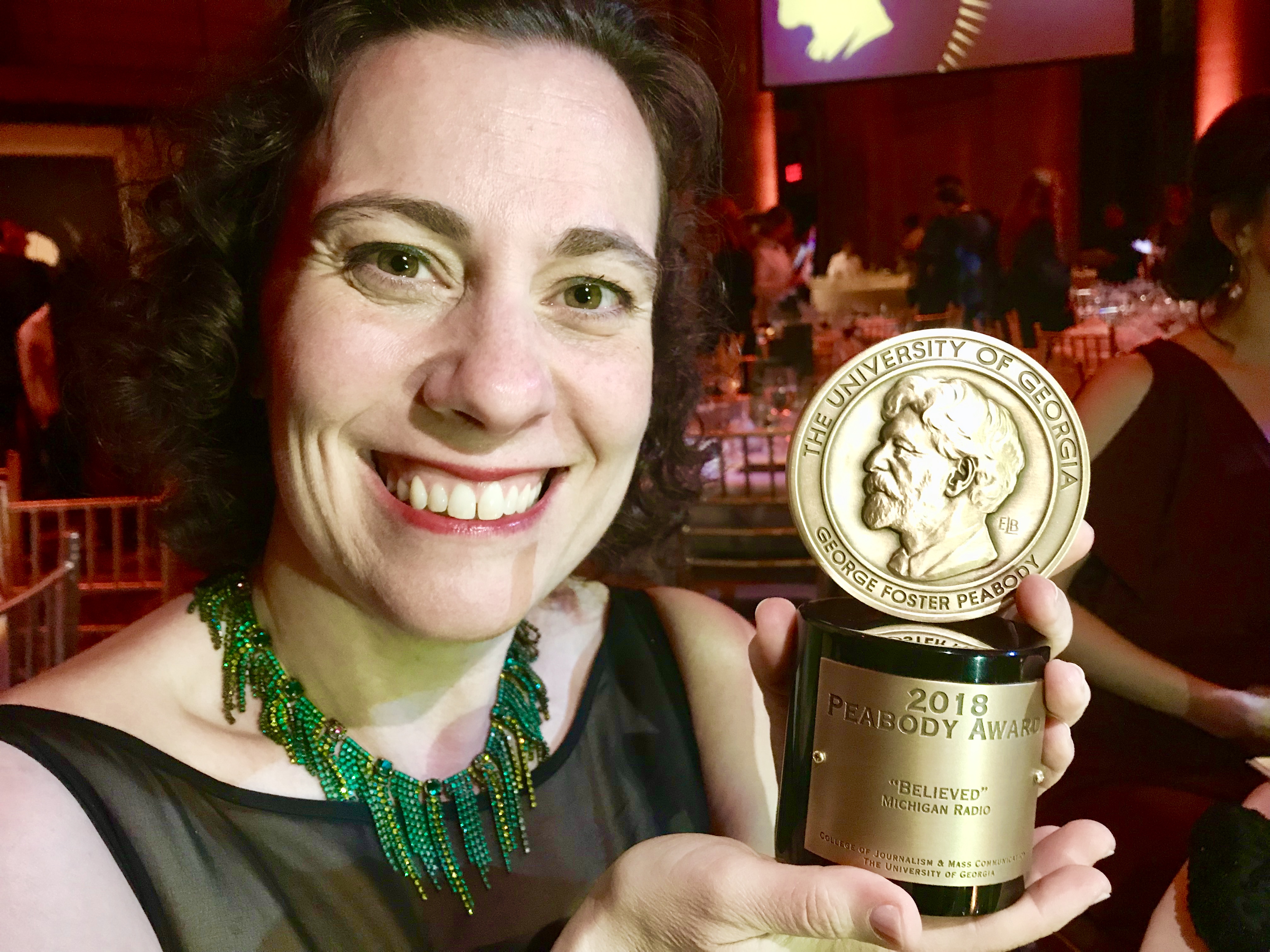
Jennifer Guerra, Knight-Wallace alum, won a
Peabody Award for Michigan Radio’s podcast, “Believed.”

I wrapped up my Knight-Wallace Fellowship in April 2018. Thirteen months later I was at Cipriani’s in New York City, sharing the red carpet with Billy Porter and the cast of “The Good Place.” I was there with my colleagues from Michigan Radio, accepting a Peabody Award for “Believed,” our podcast about the women who brought down serial sexual predator Larry Nassar. I was the project’s executive producer and head of a newly launched podcasting unit – two roles that seemed out of reach before the fellowship.

“Believed” is the first nationally-produced podcast by Michigan Radio, an NPR affiliate that covers news across the state. It is one of the most in-depth, significant projects that we’ve ever taken on as a newsroom and a station and it became the first podcast produced by a member station to be distributed by NPR. The series topped the Apple Podcast chart one week after its debut and remained in the top 30 throughout the next eight weeks. In addition, being recognized with a Peabody Award, my colleagues Lindsey Smith and Kate Wells received the Livingston Award for the podcast series. None of these honors mean as much to us as the many letters and emails we received from survivors who said they were moved by our story. They’re the reason why we did the podcast: to help people understand how Nassar was able to abuse so many girls and women for so long, and how you could have missed it, too.

The podcast was a remarkable team effort: reporters, editors, producers, fact-checkers, lawyers. You can hear each of their names in the credits, along with a list of thank yous to folks who helped out on individual episodes.

The Knight-Wallace Fellowship wasn’t mentioned in the credits, but it may as well have been. For me, the fellowship gave me the confidence and skills to advocate for myself as executive producer of this major new project. And it gave me time.

Time away from deadlines. Time to focus on craft. Time to envision the next phase of my career.

The Fellowship intentionally, methodically pushes reporters out of their comfort zones. For some, that means taking courses in rocket science or Russian literature. For others, it means taking a modern dance class and pushing past what it feels like to learn something new in a room with trained 20-year-olds who know what they are doing. The goal is to step beyond what we’re used to in the newsroom and, instead, to sit in that moment of tension and discomfort and let it affect you.

I don’t pretend to speak for everybody who’s gone through the fellowship, but I can wholeheartedly say that for me, having the opportunity to step away from the daily news grind for nine months was liberating, and career-changing.

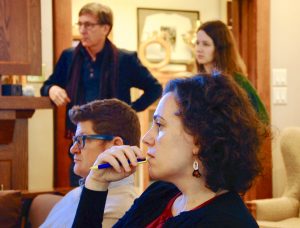
A podcast bootcamp at Wallace House in
November 2017

When I got to the University of Michigan, I thought about stories in terms of how they fit into four-and-a-half-minute radio features because that’s what I knew how to do; it’s what got me in the fellowship in the first place. But during those nine months as a Knight-Wallace Fellow, I got to entertain the possibility of something bigger. I spent hours talking to students about campus climate and civil discourse and explored new (to me) books in an ethnographic writing class with Ruth Behar. Jeremy Levine’s class on nonprofit business strategies was particularly inspiring, and, with help from Wallace House director Lynette Clemetson, helped me hone my own plan for where I wanted to take my work. By the time I left the fellowship, I had developed a vision – and an editorial and business pitch – for how to create a podcast unit within Michigan Radio.

I took that pitch back to Michigan Radio and immediately started work on “Believed” as the executive producer. As an executive producer, I was responsible for the overall production and execution of the nine-episode podcast. Since “Believed,” I’ve been working on podcasts full time. I’m now in charge of our nascent podcast unit and am currently developing limited-run and serialized shows for the station. We just released a five-part series about identity called “Same Same Different,” featuring one of my incredibly talented fellow Fellows, Regina H. Boone. My team and I are hard at work on a narrative podcast that will drop around the 2020 election. Stay tuned!

All this is to say: Apply! I don’t know how many times in your life you’ll have the opportunity to talk anytime you want to with some of the smartest people on the planet, to spend time with journalists from all over the world, to take a minute to wonder about what stories the world really needs to hear, see and read right now… and to develop the methods and frameworks to tell them.

The Knight-Wallace Fellowships for Journalists at the University of Michigan are accepting applications from U.S. applicants for the 2020-21 academic year. We’re looking for accomplished journalists eager for growth and deeply committed to the future of journalism. The deadline to apply is February 1, 2020.

Learn more about the Knight-Wallace Fellowship »

Jennifer Guerra was a 2017-18 Knight-Wallace Fellow and is Executive Producer of Special Projects at Michigan Radio, an NPR affiliate in Ann Arbor. 

Fellows Collaboration Leads to Coach’s Arrest

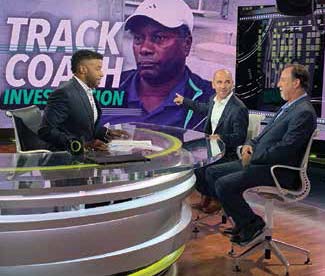
Mike Kessler ’17 and Mark Fainaru-Wada appeared on
ESPN’s “Outside the Lines” to discuss their reporting on Conrad Mainwaring
with host Ryan Smith.

It was a story that needed to be told, a story of young lives wrecked by alleged sexual abuse by a respected coach and mentor. And yet it was a story that may have never been told, were it not for the collaboration of former Knight-Wallace Fellows Mike Kessler ’17 and Greg Amante’16, who, along with investigative journalist Mark Fainaru-Wada, broke the news for ESPN’s “Outside the Lines” about Conrad Mainwaring, a 67-year-old track coach and former Olympian now accused of molesting 41 boys over the course of 44 years.

Mike was a Fellow when he first learned about the allegations against Mainwaring. It was the fall of 2016, and he was just settling in to life at Wallace House. One day he got a phone call from an acquaintance named Andrew Zenoff, who had a story he wanted to share about his late brother, Victor. In the 1970s, beginning at the age of 12, Victor had attended a boys’ sports camp for several summers at Camp Greylock in Massachusetts, where Conrad Mainwaring was a much-admired counselor. Friendly, easygoing and a natural athlete, Victor’s young life had abruptly veered off course after his time at Greylock, spiraling downward into drugs and self-destructive behavior that left his family struggling for answers. Then, just weeks before his death in a hiking accident at the age of 18, Victor revealed to his mother that he’d been sexually abused by Conrad Mainwaring. Now, decades later, Andrew Zenoff wanted the world to know what Mainwaring had done.

The problem was, Mike was unable to pursue the story. One of the conditions of the Fellowship is to agree to put aside professional work for the duration of the program. Mike remembers feeling frustrated with this, but he noted that he needed this time for himself.“The point is to step away from your primary life and not be consumed by your usual work.” Still, knowing how important Zenoff’s story was, Mike passed it along to another journalist.

Back working freelance in Los Angeles in 2018, Mike discovered that the story he had passed along had floundered. Determined to not let it slip away again, he tracked down half a dozen accusers willing to go on the record with their own accounts of sexual abuse by Mainwaring. He then approached former Knight-Wallace Fellow and ESPN producer Greg Amante ’16 with a proposal to write a magazine piece for ESPN. Mike and Greg had met in Ann Arbor in 2016. A recent graduate of the Fellowship at the time, Greg and his partner Debra had reached out to Mike and his wife when they arrived at Wallace House, and the two couples had become friends. As Mike recalls, “Greg and I got to talking about how fun it would be to work on something together.” Now, two years later, that day had come.

“I believe each of us enjoyed the feeling that we were not just doing something for ourselves, but also something positive for the Knight-Wallace Fellowship program, perhaps laying the blueprint for future collaborations between Fellows.” – Greg Amante ’16, ESPN producer

With Greg’s backing as a producer, and with the support of editors Mike Drago and Chris Buckle, along with ESPN Vice President and KWF board member Kevin Merida (who presented a seminar at Wallace House during Mike’s Fellowship year), Mike teamed up with investigative journalist Mark Fainaru-Wada. What had begun as a possible twelve-week magazine piece quickly grew into an investigation that would stretch over a year. The challenges were immense. For the four decades Mainwaring was alleged to have carried on his abuse of young boys, he’d led a life of secrecy, moving from one prestigious university to another as a track coach and counselor, keeping his past and his whereabouts hidden. Working together, Mike, Greg and Mark gathered hundreds of hours of interviews from dozens of people, in an investigation that spanned two continents. In the end, 41 survivors of sexual abuse ranging in ages from 22 to 59 came forward. On June 19, 2019, Conrad Mainwaring was arrested in Los Angeles for felony sexual battery. Less than two months later, on August 1, “Outside the Lines” released the story that Mike, Greg and Mark, with the support of their colleagues at ESPN, had worked so hard to produce.

Looking back on their efforts, Greg says: “I believe each of us enjoyed the feeling that we were not just doing something for ourselves, but also something positive for the Knight-Wallace Fellowship program, perhaps laying the blueprint for future collaborations between Fellows.” As for Mike, he sees their collaboration as a game-changer. “If I hadn’t met Greg, I wouldn’t have had the support of ESPN on such a massive scale.” He goes on to credit the Knight-Wallace Fellowship and his time at Wallace House. “Not to sound corny, but KWF gave me a chance to think about my career in a more holistic way, to let my mind wander and see what happens. That can also be very unnerving – that not-knowing – but I think it was a huge service to my personal and career growth.”

Travis Holland has been leading writing workshops at Wallace House since Fall 2008.  He is the author of “The Archivist‘s Story,” and a contributing editor at Fiction Writers Review.

Q & A with Wallace House Director Lynette Clemetson and Hovey Speaker McKenzie Funk

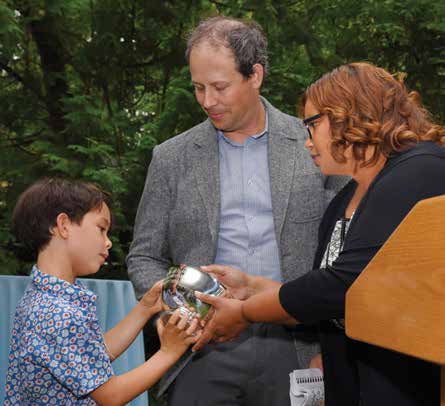
McKenzie Funk’s seven-year old son, Wilson,
carefully inspected the Hovey Bowl presented
by Wallace House Director Lynette Clemetson.

McKenzie Funk came to the Knight-Wallace Fellowship in the fall of 2011 to study the paradigm of endless economic growth and to unpack years of reporting on how governments and corporations were profiting from global warming. His 2014 book, “Windfall,” won a PEN Literary Award and was named a best book of the year by several publications. He returned to Wallace House in September to give the 34th annual Graham Hovey Lecture, and he sat down with Lynette Clemetson before the event to discuss writing on and living with the topic of climate change.


Clemetson: Discussions of climate change are most often presented through science or politics, or the clash between the two. What made you want to explore it through financial gain?

Funk: I wasn’t a climate change person. I grew up being interested in environmental issues because of my parents and where I grew up in Oregon. But precisely for the reasons you describe – that it’s a political fight or a scientific question – as a narrative writer, I had shied away from it.

Clemetson: And what changed that?

Funk: It was 2006, and I was living in New York trying to get my freelance career going. I got an email from the Environmental News Network, a short one or two line item about something called a sovereignty operation up in northern Canada, a group of Canadian Rangers there to defend the Northwest Passage. And I thought, “that’s really weird.” They mentioned a climate connection, and it just sounded very different from everything else I’d heard about people reacting to climate change. I called the PR people at the Canadian Forces to ask if I could go along on the next one. They were overjoyed because this was basically aimed at the United States. They wanted the world to know that the Canadian military was up there staking a claim to the melting North.

Clemetson: And what made you want to follow the thread and keep reporting?

Funk: In the background of all of this, “An Inconvenient Truth” had just come out. There was an Intergovernmental Panel on Climate Change report coming up the next year. There was the prospect of climate legislation coming up in the Senate. It was all sort of bubbling. My story from the Canadian Forces expedition was published in Harpers in August 2007. Around the same time, the Russian government sent two mini subs down to the bottom of the ocean at the North Pole and planted a Russian flag, and suddenly people were saying, “Wait a minute, what’s going on?

Clemetson: You approach the global crisis through three broad themes – melt, drought, deluge. And your themes are starkly organized around geography.

Funk: Yes, the north versus the global south, high latitudes versus middle latitudes. It’s obvious if you pull back and think about it. The northern countries are the ones that have been wealthiest. We not only have enough in our war chest, as it were, to survive some of these impacts, but we can, in some cases, benefit. And of course, we’re the biggest historic emitters of the carbon that’s causing this problem. That remains true even as we outsource our industrial production to China. We are the end users of much of that carbon.

Clemetson: In the weeks leading up to your talk, this topic seemed to be ever present. President Trump was angling to buy Greenland. The Bahamas was devastated by a hurricane. Do you see this issue everywhere now?

Funk: Once you see it, it’s everywhere. We just moved to Oregon, to a town called Ashland, which is at the very bottom of the state, near the border of California, not so far from Paradise, California. The town is famous for its Shakespeare Festival, which brings in tourists. The economy is basically built on how nice the town is. When we arrived, it had the worst air quality in the entire country because it was ringed with wildfires. It’s something that’s happened consistently summer after summer for the last several years. This part of southern Oregon is just burning, and the smoke permeates everything. My wife Jenny had to stay to attend school but the kids and I, we dumped our bags, our boxes and left immediately, because we were wearing smoke masks out on the street. It was like this apocalyptic new reality.

Clemetson: And how did you feel about leaving?

Funk: I was very aware that we had the privilege to be able to pack up, get in our car and drive somewhere. There were many families in the region that couldn’t get away and were just suffering through the smoke. Businesses were collapsing. It was actually the first time that it became real for my life. I started to think strategically about moving north, back to Seattle, back to a place where, if you look at the impacts, it will be safer.

Clemetson: Your book paints a picture in which the people who can afford to win will win. And people who can’t will lose.

Funk: Yeah. The gaps between rich and poor, between dark and light, between black, brown and white are set to grow unless we’re really careful about this. It’s a justice story essentially. The hope is that if we can more collectively recognize the systemic issues, the more we will take steps to adapt more fairly. A lot of the justice questions have to do with how we adapt and who we adapt for. We’ve done so little in terms of making cities more resilient and in terms of thinking about how we’re going to prepare for the storms or heatwaves or fires. There is still a lot of room to make our responses more equitable.

Clemetson: Some people come to the fellowship to pursue something new. You were already deeply involved in this reporting and in writing a book when you arrived. So how did you approach your time?

Funk: There was a Great Lakes Water Wars class that was outstanding, and Andy Hoffman’s class in the Business School on how corporations were confronting climate change. A lot of the section in the book about Shell Oil was informed by that class. But I also spent a lot of time in the fellowship on seemingly unproductive things. Jenny was pregnant. We spent time hiking in the Bird Hills Nature Area, canoeing on the Huron River. And I spent a lot of time chasing my dog.

Clemetson: Chasing your dog?

Funk: We lived in the house that Matt Power had lived in when he was a Fellow. It was donut shaped, with a central staircase. It was perfect for running in circles. And I would just chase the dog around and around, for a really long time, every day. It was great. It was one of the most important things, just having time to think. To think about what I had gathered and to put it all together.


Wallace House Presents McKenzie Funk on Climate Change

The 34th Graham Hovey Lecture

“Seeing Green: The Business and Inequity of Climate Change” with McKenzie Funk ’12

September 10, 2019 | 5 p.m.

Wallace House Gardens
620 Oxford Road, Ann Arbor

Welcome remarks by Mark S. Schlissel, President, University of Michigan

Watch the discussion here »

While the issue of climate change rises in importance to the U.S. electorate, players in energy, banking and business are cashing in on the environmental crisis. McKenzie Funk, 2012 Knight-Wallace Fellow, is the author of “Windfall: The Booming Business of Global Warming.” Join him for a critical discussion of drought, rising seas, profiteering, and the hardest truth about climate change: It’s not equally bad for everyone.

Funk writes for Harper’s, National Geographic, Rolling Stone, Outside, The New York Times Magazine and the London Review of Books. His 2014 book “Windfall” won a PEN Literary Award and was named a book of the year by The New Yorker, Mother Jones, Salon and Amazon.com. A National Magazine Award and Livingston Award finalist, Funk won the Oakes Prize for Environmental Journalism for his reporting on the melting Arctic and has received fellowships at the Open Society Foundations and MacDowell Colony for his forthcoming work on data and privacy.

Funk studied philosophy and comparative literature at Swarthmore College and capitalism and the paradigm of endless growth as a 2012 Knight-Wallace Journalism Fellow at the University of Michigan. He speaks five languages and is a native of the Pacific Northwest, where he lives with his wife and sons.

The annual Graham Hovey Lecture recognizes a Knight-Wallace journalist whose career exemplifies the benefits of a fellowship at the University of Michigan and whose ensuing work is at the forefront of national conversation. The event is named for the late Graham Hovey, director of the fellowship program from 1980 to 1986 and a distinguished journalist for The New York Times.

Hop Off the Hamster Wheel, Apply for a Knight-Wallace Fellowship


2017 Knight-Wallace Fellows Laurent Richard and Delece Smith-Barrow
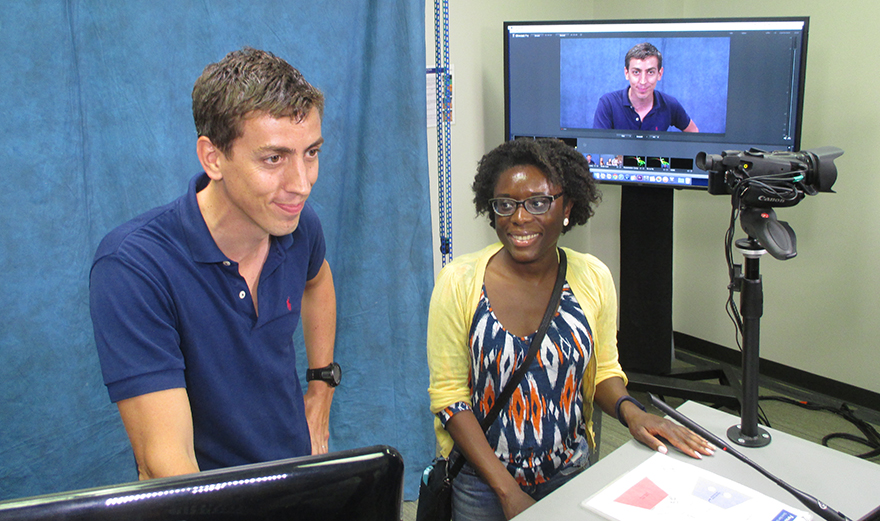
2017 Knight-Wallace Fellows, Laurent Richard and Delece Smith-Barrow, at a multimedia workshop.


After producing 280 stories within three years, a busy reporter takes a Knight-Wallace Fellowship and an eight-month dive into research on under-reported education stories.


Education reporter and editor Delece Smith-Barrow goes to Medium to share how a Knight-Wallace Fellowship gave her the time and resources to pursue ambitious, thoughtful stories.  Taking a deep dive into how top-tier universities recruit faculty of color, Smith-Barrow writes about auditing education courses at Michigan, doing comparative research into other universities and having time to acquire new skills and enjoy life.

Read Smith-Barrow’s reflection of her fellowship year and return to the work world on Medium.

The Knight-Wallace Fellowships for Journalists at the University of Michigan are accepting applications from U.S. applicants for the 2019-20 academic year. We’re looking for accomplished journalists eager for growth and deeply committed to the future of journalism. The deadline to apply is February 1, 2019.

Delece Smith-Barrow is a senior editor at The Hechinger Report. As a 2017 Knight-Wallace Fellow, she studied how top-tier universities recruit faculty of color.

Room for Something New: Apply for a Knight-Wallace Fellowship


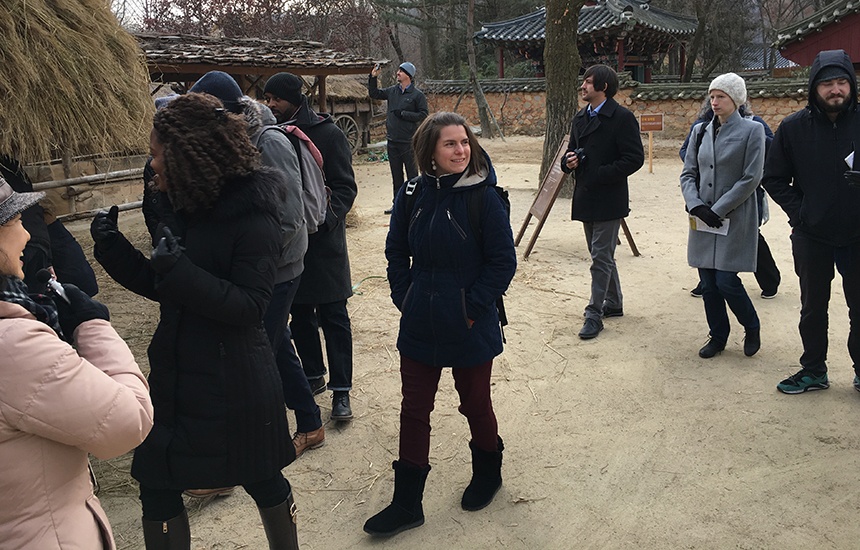
Anna Clark and her cohort of Fellows visit a Korean open-air museum during a Knight-Wallace news tour to South Korea.


How an independent journalist breaking stories on the Flint water-crisis found inspiration and turned her reporting into a book.

Need time away from daily deadlines to dig deeper and become an expert on an issue or topic? Anna Clark goes to Medium and shares how a Knight-Wallace Fellowship brought something new to her life: intellectual space.  From taking classes at the University of Michigan Law School to workshops and collaborative learning with her fellow Fellows, Clark writes “The Knight-Wallace year replenished my spirit at the time I needed it most.”

Clark wrote many of  the early stories about the lead discovered in Flint’s drinking water before coming to the program. Following the fellowship, she spent 14 months writing the first full account of the Flint water crisis. Her book, “The Poisoned City: Flint’s Water and the American Urban Tragedy,” was published this July.

Read Clark’s reflection of her fellowship journey on Medium.

The Knight-Wallace Fellowships for Journalists at the University of Michigan are accepting applications from U.S. applicants for the 2019-20 academic year. We’re looking for accomplished journalists eager for growth and deeply committed to the future of journalism. The deadline to apply is February 1, 2019.

Anna Clark is an independent journalist based in Detroit and author of “The Poisoned City: Flint’s Water and the American Urban Tragedy.” As a 2017 Knight-Wallace Fellow, she studied how chronic underfunding of American cities imperils its residents.

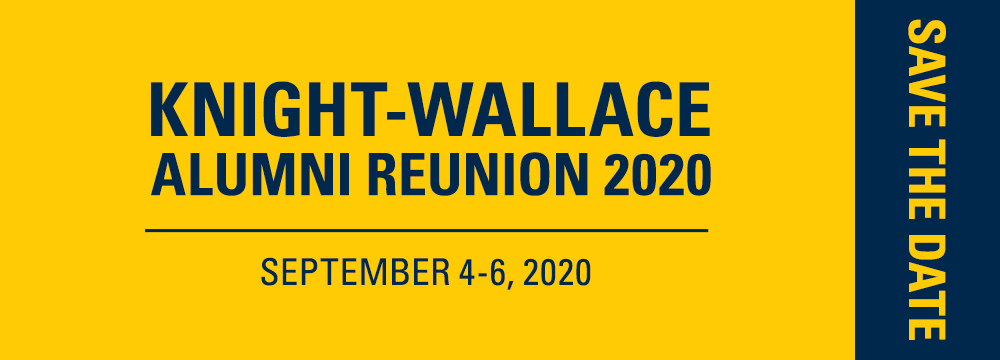
Knight-Wallace Reunion 2020


For Fellowship Alumni:

We’ve decided to space out the frequency of our beloved fellowship reunions to every five years. The date for our next big get-together will be September 4-6, 2020. We expect that Labor Day weekend, with plenty of notice for advance planning, will entice you and your families back to Ann Arbor for a beautiful September visit.

We hope to see Fellows from what will by then be all 47 fellowship classes for a weekend of engaging events, dinner and dance, and, of course, barbeque at Wallace House.

As our plans develop, we’ll be in touch with information on hotel bookings, RSVP’s and more.

For now, save the date!

Wallace House

Q & A with Wallace House Director Lynette Clemetson and Hovey Speaker Bernice Yeung

Bernice Yeung arrived as a Knight-Wallace Fellow in 2015, following an intense period of collaborative reporting that produced two award-winning investigations, Rape in the Fields and Rape on the Night Shift. Since the Fellowship, she has published a book, “In a Day’s Work: The Fight to End Sexual Violence Against America’s Most Vulnerable Workers.” Bernice returned to Wallace House in September to give the 33rd annual Graham Hovey Lecture. Prior to the lecture, Lynette and Bernice had a conversation discussing the relevance of her reporting in the context of the #MeToo Movement.


Clemetson: You first started writing about sexual abuse of low-wage workers in 2012. How do you view the cultural change in our recognition of and conversation around the issue?

Yeung: There has been a complete transformation of the public dialogue. When we started in 2012, the campus sexual assault conversation was ongoing and robust. Simultaneously, the military sexual assault investigations were happening. There was a slow drumbeat of looking at sexual violence in different corners of society. But now, post-#MeToo, it is part of the daily headlines. The conversation is almost inescapable. There is a completely different resonance now.


Clemetson: And yet, much of the current conversation is around prominent figures. Do you think that the people that you focused on are being represented enough?

Yeung: There is a part of the movement that is about understanding the prevalence of sexual violence. And then there is a fascination with the comeuppance aspect of the story, an interest in famous people and the fall of power. I think more attention ought to be paid to those who are less powerful in terms of their professional and financial positions.

I recently reported a story where I talked to women truck drivers, public health workers, government workers, and hospital techs. They were excited to see the way #MeToo has opened up a space to have these conversations. But a lot of them still wonder whether that opening has reached them yet. They were impressed by the famous women who had come forward, amazed and grateful that they had spoken up, but they also really wondered why when they themselves had spoken up, why they weren’t heard in the same way.


Clemetson: What drew you to this particular corner of the issue?

Yeung: There was an element of it that I was inclined to be curious about because of my own family’s immigrant background to the United States. I had done some stories on domestic violence and immigrant women and had seen the holes and gaps in policy and law when it comes to assisting immigrant women, and how seeking any kind of recourse or help was so formidable for those women.


Clemetson: How did approaching the issue for a book lead you to new insights?

Yeung: We tend to think of sexual harassment as a problem between two individuals, as a behavioral problem by a bad apple. The book helped me look at policies, how companies operate, how industries function and how they create environments that make certain workers more vulnerable. So much of our labor law enforcement is predicated on the worker making a complaint. And when you have a population who are low wage, immigrant, perhaps with tenuous immigration status, living on the edge of poverty, expecting them to come forward is not realistic. We don’t have a realistic way for them to engage with the resources that would enable them to put an end to labor abuses.


Clemetson: There seems to be a greater appetite and more space now across platforms for journalism that explores issues systemically.

Yeung: Yes. I am lucky be a journalist in this moment where there is space for investigative journalism about systemic issues. I have always been interested in melding sociological strategies with journalism. My study plan was looking at how social science research strategies could be applied to journalism. I think there is something about what sociology provides, a systems-based orientation, plus an attempt to quantify, along with qualitative human interviews, that makes sociology a kindred spirit to journalism.


Clemetson: How did the fellowship inform how you approached the book?

Yeung: I don’t think I would be the same journalist I am now if I had not done the fellowship. I don’t think my book would exist. The mental and emotional space that the fellowship provided made it possible to do this book. I was coming off several years of looking at this issue when I arrived, and the mental fatigue was real. It was really important to give myself some time to stop, regroup and fortify myself so I could job back into it.

And there were so many resources at the university that I drew from. For instance, Catherine MacKinnon in the University of Michigan Law School, is THE person, THE scholar, who defined what sexual harassment is. Having the opportunity to learn from her and others like her left me astonished. What I was able to bring to the book in terms of a contextual and systemic look, that was possible because of the time I had at the university.


Clemetson: As this issue has exploded, it has also caused turmoil in many news organizations.

Yeung: I have been so heartened and impressed by the incredible reporting that has been done by the dogged and sensitive journalists working on this issue, the amount of vetting and checking, and deep research and reporting. I don’t know if the general public appreciates how serious and rigorous the reporters have been on these stories. And then you have journalists who are raising this issue, even as they are having to report on their own organizations and call into question the authority of their own employers. I just have so much respect for the work that is being done, and I appreciate those who are doing the work.


Clemetson: Do you feel that we truly are in a moment of change, a substantive shift?

Yeung: I see parallels to the Anita Hill/Clarence Thomas moment. I am sure we’ll look back on #MeToo and see it as a watershed moment and a shift in the cultural consciousness. But I think the question is, now what? There is work being done around prevention and solutions, and those are harder stories to cover. As reporters, we want things to be concrete and evidence-based, something we can measure. The slow culture change that seems critical to shifting the way we deal with sexual harassment is harder to document. But I think that is where we need to be paying more attention now.


Clemetson: So you intend to keep going.

Yeung: As much as I can, yes. I intend to. I am in that space now where I want to know that it is all going to lead to something, some tangible example of change. I am definitely watching and tracking. It is important to tell those stories about how change can happen, how reform can happen.


Korea Without Frilly Clothes

A highlight of the trip: revisiting my grandparents’ place in Seoul and digging up old photos that I didn’t
find as interesting on previous trips.
Photo submitted by Candice Choi

Staring at video of the Samsung chairman allegedly with prostitutes, I knew this trip to Korea would differ from my past visits.

The hidden camera footage was published by Newstapa, an investigative group formed in 2012. The newsroom was one of the first stops for the Knight-Wallace Fellows and signaled I’d be seeing the country from new perspectives.

My last trip to Seoul was more than 20 years ago, when I was in high school. Upon arriving for childhood visits, my conservative grandparents would take my brother and me shopping for stuffy clothes and make us wear them to a formal restaurant. The ritual made me see new clothing and the entire country of Korea as suffocatingly superficial.

Yet after learning the Fellows were headed to Korea, I grew excited about returning with a reporter’s mindset. I read up on modern Korean history and politics and began to see the country’s vibrancy.

Among our stops were a museum of antique Korean furniture, the taping of a K-pop TV competition, and a U.S. military base. We also went to the Demilitarized Zone, which jarringly played to tourists with cardboard cutouts of soldiers for photo ops while also reminding us of the peninsula’s tragic past.

Our visit would take on added significance weeks later, when the leaders of North and South Korea would meet at the same site to discuss denuclearization and perhaps formally ending the Korean War.

Back at the Newstapa office, our host was a young woman who left her job with the police force to become a reporter, inspired in part by the movie “Spotlight.” She wore a modern black hanbok that gave her an authoritative presence as she explained libel laws that allow journalists to be criminally charged.

Newstapa nevertheless published video that appears to show the Samsung chairman with prostitutes. Adding to the intrigue, the tapes were apparently obtained for blackmailing purposes before ending up with Newstapa.

It was ethically messy, making the decision to publish all the more daring.

Newstapa’s model of relying on reader donations is also provocative. The idea is to gain public support as an independent news source in a society where conglomerates have huge power. The approach is a challenge to news outlets around the world.

Outside newsrooms, some of the best moments were unscheduled, such as people watching on the subway and wandering alone on the striking campus of Ewha University. Over a late night coffee, a friend who works as a TV sports analyst explained his quest to emulate the argumentative style of New York sports radio. I laughed imagining a Korean version of “Mike and the Mad Dog.”

The highlight of the trip, though, was returning to my grandparents’ apartment, which was largely unchanged from my childhood. My grandfather died of stomach cancer years ago and my grandmother has Alzheimer’s disease, making it too late to ask about their pasts. But I dug out stacks of old photo albums I had never bothered looking at before.

The black-and-white images showed them in unfamiliar contexts – smiling on a train, mingling at a garden party, wandering down a Seoul alley. I realized how little I knew about their lives, which spanned Japanese colonialism, the Korean War and the country’s economic boon.

Growing up, I thought my grandparents were overly conservative and limited in their worldview, traits I chalked up to their Korean background. In the years since, I’ve come to see the immaturity of those judgments, a realization this trip helped underscore.

Candice Choi is a 2018 Knight-Wallace Fellow and Food Industry Writer for the Associated Press (New York, N.Y.).

Figure it out – Apply for a Knight-Wallace Fellowship at the University of Michigan

Now is the fight time to apply for a Fellowship
Mosi Secret 16′ explains how a Knight-Wallace Fellowship
changed his life both personally and professionally.

Mosi Secret, Knight-Wallace Fellows Class of 2016, shares on Medium how his Fellowship year changed the trajectory of his professional life and how it impacted his personal life.

He explains why he left his job as a reporter for The New York Times, a position that for many represents the pinnacle of American journalism. 

He discusses how it felt walking away from his comfortable life in New York in pursuit of what he describes as an ill-defined dream. Secret maintains that his time at the University of Michigan was the beginning of a march toward a deeper and more sustainable sense of happiness and professional satisfaction.

“If you’re thinking of changing your life and career,” said Secret, “there’s no time like the present. Apply.” Learn more what about what attracted him to the program.

The Knight-Wallace Fellowships for Journalists at the University of Michigan are accepting applications from U.S. applicants for the 2018-19 academic year. We’re looking for accomplished, mid-career journalists eager for growth and deeply committed to the future of journalism. The deadline to apply is February 1, 2018.

Read Mosi Secret’s reflection on his fellowship year on Medium.


Mosi Secret was a member of the Knight-Wallace Fellows Class of 2016. He is an independent journalist based in Brooklyn, NY.  Find out more about what Mosi Secret has been doing post-Fellowship.