Reflections From Our Fellows Trip to the Balkans

Joseph Sywenkyj is an American photographer of Ukrainian descent who has lived and worked in Ukraine for 20 years.

I arrived in Ann Arbor from Ukraine with my family in August 2024 to begin my Knight-Wallace Fellowship. Air raid sirens wailed as our train pulled out of Kyiv. Days later, I was attending a seminar on Michigan politics and wondering, “What am I doing here?”

By spring 2025, when my cohort set off for three countries of the former Yugoslavia — Croatia, Bosnia and Serbia — I had mostly adapted to life without war. I was looking forward to learning how other war-torn European societies had attempted the difficult transition to peace and democracy.
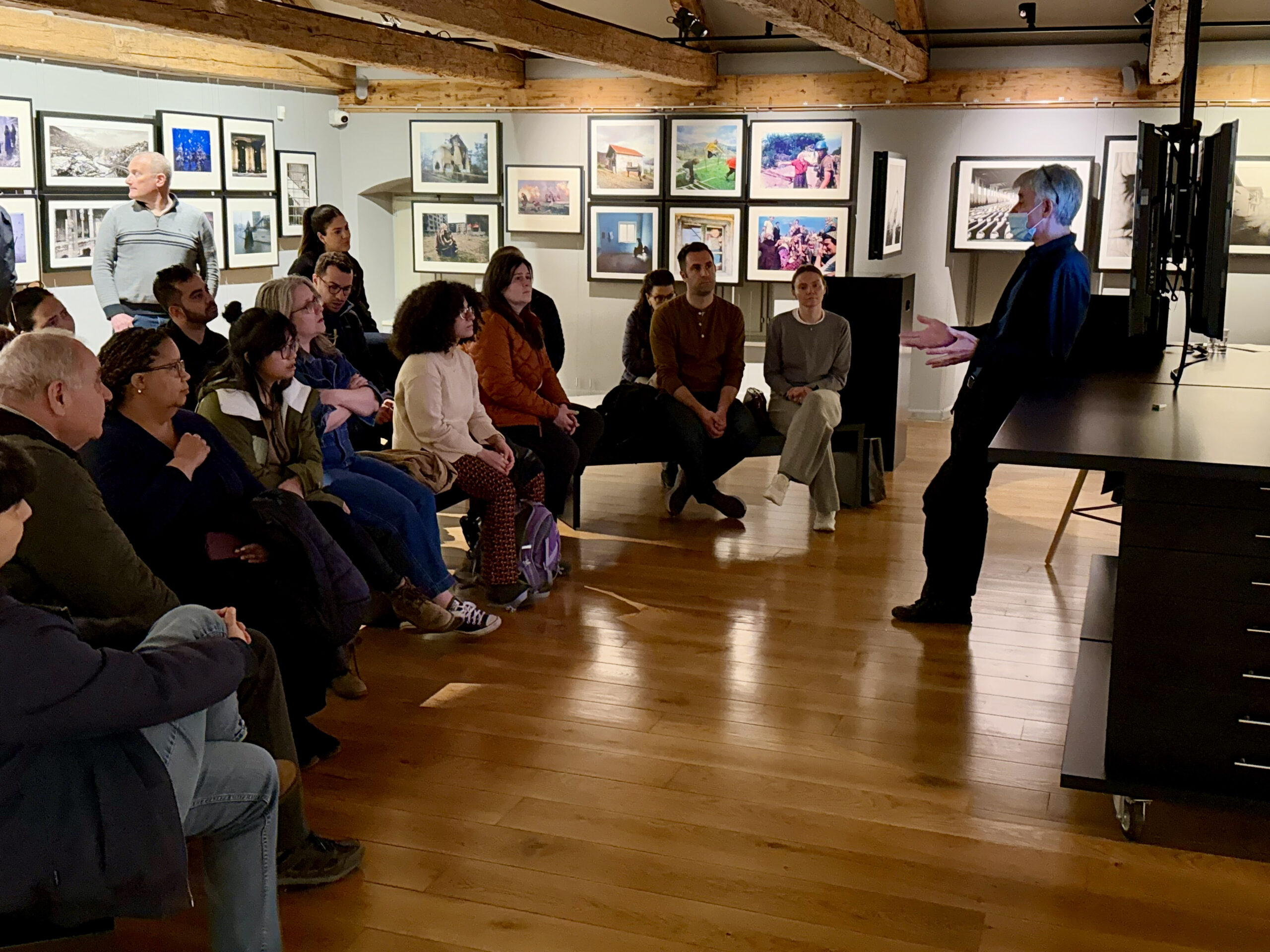
We began our trip in the Croatian coastal city of Dubrovnik, where we were welcomed by our guide, Bosnian photojournalist Ziyah Gafic. We toured a hilltop museum that chronicled the 1991 siege of Dubrovnik and visited photographer Wade Goddard, who ran a gallery dedicated to war photography. I had studied images of the Balkan wars as a young photographer, but to view them well into Russia’s full-scale war against Ukraine was something entirely new. My wife wept as I fought tears and tried to comfort her. It was like looking in a mirror.

Politicians, journalists, activists and religious leaders in Sarajevo helped us understand how selective memory, language and old animosities are harnessed to spark violence and war. Many guest speakers had warnings to share. Aida Čerkez, who was the Sarajevo bureau chief for the Associated Press during
the war, recounted the mass denial before the Serbs began their 1992 attack. She cautioned: “Try to resist the denial, so you can recognize it in time to react. … You cannot save the world. But what you can do, privately and professionally, is position yourself toward the problem.”

The most haunting part of our trip was visiting Srebrenica, where Bosnian Serb forces murdered more than 8,000 Bosnian Muslims, most of them men and boys, while United Nations peacekeepers failed to act. We toured the cemetery and memorial center with curator Azir Osmanović, who survived the 1995 genocide at age 13. He told us more Bosnian Serbs deny the genocide today than they did in the 1990s. As a Ukrainian, I took note of the work we must do to commemorate the victims of Russia’s war against us in the years ahead.

We then traveled to Belgrade, the capital of Serbia, where I was surprised to feel a sense of hope. Our guide, Serbian photojournalist Marko Drobnjakovic, introduced us to courageous investigative reporters and election observers. And we observed peaceful, student-led protests against corruption,
which had spread throughout the country. We were witnessing history in action.

I remain inspired by the people we met, working tirelessly to heal wounds of war and develop more open, accountable and democratic societies.
Swift Action for the Hardest Hit

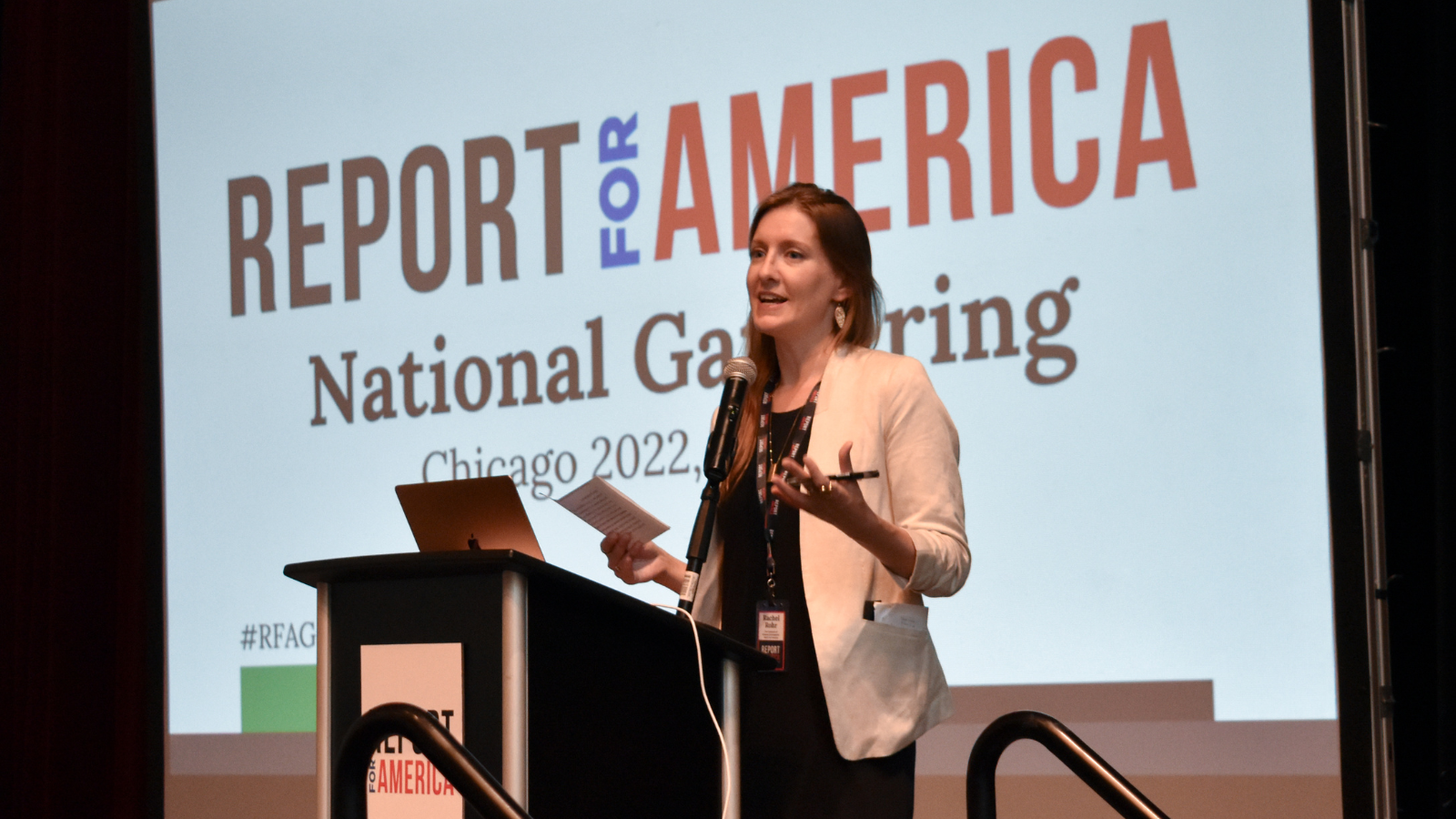
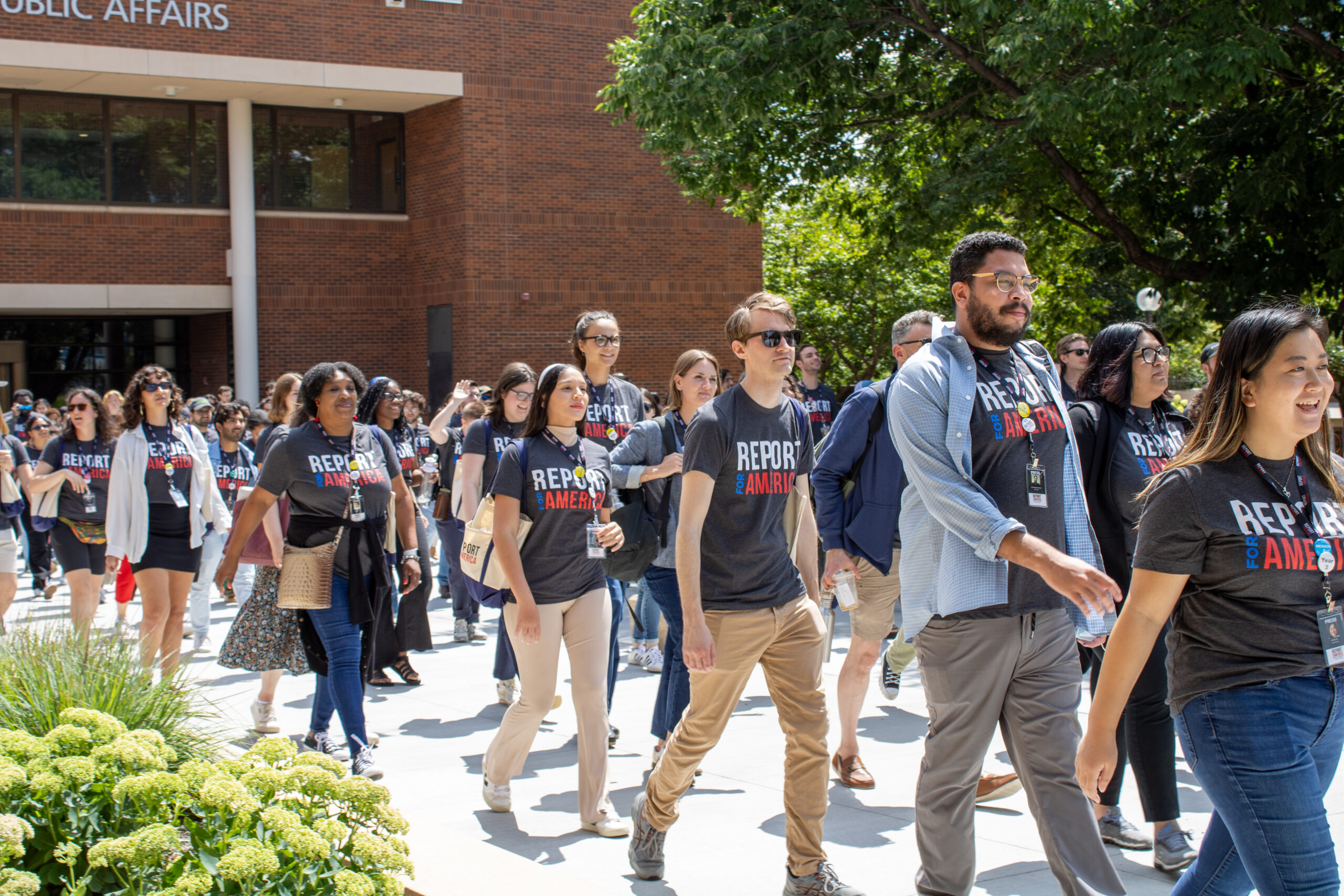
Rachel Rohr is vice president of program development at Report for America, a national service program that places journalists into local newsrooms to report on under-covered issues and communities.

Like the Knight-Wallace Fellowships, Report for America runs on a tight programmatic cycle. We had selected our 2025-26 corps members and our program year had started when Congress voted to rescind funding for public media in July. About 20% of the local newsrooms Report for America has supported since 2018 are public media stations. We reached out across our network to find out who was hardest hit.

In Alaska, one of our alumni at Alaska Public Media helped direct us to two urgent situations.

KRBD, a station in the southeast city of Ketchikan, was about to hire reporter Hunter Morrison when 37% of its budget evaporated. The small newsroom typically has a news director and one reporter covering a region that includes a busy tourist and fishing community as well as Alaska’s only Native American reservation. Not being able to fill the vacant reporter position would leave 20,000 people without essential local news coverage.

At KOTZ, a one-person newsroom above the Arctic Circle in Kotzebue, the station’s board and leadership told the news director, Desiree Hagen, that they would have to close the radio station within a year. In addition to serving as the news director, Hagen is the only reporter at KOTZ, which receives 41% of its funding from the Corporation for Public Broadcasting.

Shuttering the newsroom would cut off the primary local news source and safety information for approximately 10,000 people, most of whom are Alaska Natives.

Most of the stories Hagen covers involve weather alerts, Indigenous cultural programming, and news
on issues such as road closures, subsistence meetings, and essential hunting and fishing information —
updates vital for a community where 60% to 80% of the diet depends on harvested wild food. Shuttering
the newsroom would cut off the primary local news source and safety information for approximately 10,000 people, most of whom are Alaska Natives.

Report for America corps members from across the country.

We accepted Hagen and Morrison as corps members. Instead of our usual grants that cover 50% of reporters’ salaries in the first year, we’ll cover 100% of the reporters’ salaries and benefits in the first year — something we’ve never done before.

We’ll also assist the newsrooms with funding and sustainability strategy. And the reporters will be able to enjoy all the perks of being corps members. That includes mentorship, training, professional memberships and — perhaps best of all for reporters in rural and remote places — a supportive peer network of Report for America corps members and alumni.

As Desiree Hagen, who is deeply committed to continuing her work as news director and reporter, told us, “The funding prevents the voices of rural Alaska and the Arctic from going silent.”


This article is part of Rising to Meet the Moment, a series from the Fall 2025 issue of the Wallace House Journal, featuring reflections from Knight-Wallace alumni, Wallace House board members and the Livingston Awards community on meeting today’s challenges with focus, resilience and resolve. Read more stories from our series:

Christopher Baxter, “Unexpected hope

Lynette Clemetson, “Stepping up with focus and resolve

Hayes Ferguson, “Nurturing innovation, adaptability and purpose

Stephen Henderson, “Choosing Civility

Samantha Henry, “The future of our profession: student journalism

Tracy Jan, “News deserts and fewer watchdogs

Margaret Low, “Game Over? Not a chance

Peggy Lowe, “Defunded, but not defeated

Amy Maestas, “Building trust through community collaborations

Kunal Majumder, “Defending the right to report

Seema Mehta, “Why we keep reporting

Rachel Rohr, “Swift action for the hardest hit

Gerard Ryle, “We will not retreat

Laura Santhanam, “Preserving knowledge

Mazin Sidahmed and Maria Arce, “Training newsrooms to serve immigrant communities

Celeste Watkins-Hayes, “Bending without breaking: resilience in academia

Thomas Zurbuchen, “Never let a good challenge go to waste

Stepping Up With Focus and Resolve

Lynette Clemetson is the director of Wallace House Center for Journalists.

This is my 10th academic year as director of Wallace House. Over the years, among the key benefits I tout when speaking to journalists about our programs is the university as refuge, a sturdy port in the ever-turbulent storm that is the journalism industry.

As the last academic year came to a close, that didn’t feel like something I could continue to promise with any degree of confidence.

The Trump administration was targeting universities around the country, threatening colossal funding cuts and issuing demands that reached into governance, hiring, admissions and academic freedom. The University of Michigan discontinued its strategic diversity plan. Some departments were scrubbing websites of words and phrases that could draw government retribution. It was unclear whether international students — our own international Fellows included — would be granted entry to the United States.

The threats and absurdities haven’t gone away. The people in our extended Wallace House network — journalists, scientists, scholars, policy and legal experts — are prime targets in the strategic attempt to weaken institutions and consolidate presidential power.

Yet in the face of numerous obstacles, campus this fall still brims with possibility. The harsh realities of a raw and hostile national landscape are being met with expressions of creativity, collaboration, innovation, active listening, welcome and compassion. There is a tangible focus and resolve across departments and faculty, in student activities and community events that offer an ever-present reminder of what makes the University of Michigan special.

As our new Knight-Wallace Fellows move through the intellectual bounty of the fall semester, I am reminded time and again that the qualities that drew me here as a Fellow and that infuse my enthusiasm for outreach as director are no less true now than they have ever been.

But from our perch at Wallace House, each week we’re seeing inspiring evidence across our network of people stepping up boldly with both short-term assistance and long-term resolve.

The excellent work of alumni also reminds me that the dedicated journalists who Wallace House has helped to develop and empower over five decades are well-positioned to meet the moment.

And so this issue of the Wallace House Journal is built around resilience. Not naiveté or blind optimism. But the kind of clear-eyed focus and mission-driven leadership needed to respond to the multiple serious challenges we face with fortitude and vision.

We’ve all witnessed our share of feckless leadership over the past several months, from media executives and university presidents who somehow believed that cowering and capitulating might provide them protection. But from our perch at Wallace House, each week we’re seeing inspiring
evidence across our network of people stepping up boldly with both short-term assistance and long-term resolve.

In these pages, you’ll read stories of our colleagues reaching across organizations to lend financial, editorial and strategic support; about collaborations to build community-level trust and cross-border accountability; and about journalists pairing with scholars to rescue data essential to the work of both. We can all draw strength from these vignettes — and hopefully also ideas.

If after paging through, you feel inspired to reach out to a Knight-Wallace Fellow you haven’t spoken to in a while, or one you have never met, a Livingston Award winner you applauded, a faculty member whose research you’ve been wondering about, a board member you struck up a friendship with, or an engaged
community member you had a great conversation with at one of our events, go ahead and reach out. Check in.

That’s what networks are for. This is an exceptional one — and its members are not in retreat.


This article is part of Rising to Meet the Moment, a series from the Fall 2025 issue of the Wallace House Journal, featuring reflections from Knight-Wallace alumni, Wallace House board members and the Livingston Awards community on meeting today’s challenges with focus, resilience and resolve. Read more stories from our series:

Christopher Baxter, “Unexpected hope

Lynette Clemetson, “Stepping up with focus and resolve

Hayes Ferguson, “Nurturing innovation, adaptability and purpose

Stephen Henderson, “Choosing Civility

Samantha Henry, “The future of our profession: student journalism

Tracy Jan, “News deserts and fewer watchdogs

Margaret Low, “Game Over? Not a chance.

Peggy Lowe, “Defunded, but not defeated

Amy Maestas, “Building trust through community collaborations

Kunal Majumder, “Defending the right to report

Seema Mehta, “Why we keep reporting

Rachel Rohr, “Swift action for the hardest hit

Gerard Ryle, “We will not retreat

Laura Santhanam, “Preserving knowledge

Mazin Sidahmed and Maria Arce, “Training newsrooms to serve immigrant communities

Celeste Watkins-Hayes, “Bending without breaking: resilience in academia

Thomas Zurbuchen, “Never let a good challenge go to waste

Why We Keep Reporting

Seema Mehta is a political reporter at the Los Angeles Times.

I’ve covered politics at the Los Angeles Times for nearly two decades, and I cannot recall a more challenging time to do this work. The nation is deeply polarized. Many voters believe the mainstream media is fake news and won’t talk to us, making it harder to tell stories that reflect the viewpoints of all Americans. It seems impossible to keep up with the firehose of news coming out of the White House, including many policies that disproportionately affect Californians.

The ICE raids that began in Los Angeles in June and the ensuing deployment of the National Guard on the streets of the nation’s second-largest city are prime examples. In the early days, my colleagues and I wrote about the chaos that was violently unfolding amid one of the largest immigrant populations in the U.S., the legalities of the efforts, the administration’s justifications and Democrats’ opposition.

In the midst of an avalanche of breaking news, I heard about a veteran who had self-deported to South Korea.

Sae Joon Park legally immigrated when he was 7 years old and grew up in Los Angeles, becoming part of Southern California’s skateboarding and surfing scene in the 1980s.

After graduating from high school, Park joined the Army and was deployed to Panama in 1989 as the U.S. tried to depose the nation’s de facto leader, General Manuel Noriega. Park was shot twice, honorably discharged and awarded a Purple Heart.

Park said he spiraled into addiction as he sought to self-medicate his PTSD, leading to drug convictions and prison time. He eventually sobered up, moved to Hawaii and raised two children. Every year, Park was required to check in with federal officials and show that he was employed and sober.

People are willing to speak to us during the most harrowing moments of their lives, and we are privileged to be able to share their stories.

During his most recent check-in, Park was about to be detained and deported, but immigration agents placed an ankle monitor on him and gave him three weeks to get his affairs in order and self-deport. He is not allowed to return to the United States for 10 years. He worries he will miss his mother’s passing and his daughter’s wedding.

I spoke with him two days after he left the United States. He remains in South Korea.

Park’s saga is not uplifting. But it is a reminder of the importance of our work and motivation to keep doing it, to show the real-world impacts of decisions being made in the halls of power. People are willing to speak to us during the most harrowing moments of their lives, and we are privileged to be able to share their stories.


This article is part of Rising to Meet the Moment, a series from the Fall 2025 issue of the Wallace House Journal, featuring reflections from Knight-Wallace alumni, Wallace House board members and the Livingston Awards community on meeting today’s challenges with focus, resilience and resolve. Read more stories from our series:

Christopher Baxter, “Unexpected hope

Lynette Clemetson, “Stepping up with focus and resolve

Hayes Ferguson, “Nurturing innovation, adaptability and purpose

Stephen Henderson, “Choosing civility

Samantha Henry, “The future of our profession: student journalism

Tracy Jan, “News deserts and fewer watchdogs

Margaret Low, “Game Over? Not a chance

Peggy Lowe, “Defunded, but not defeated

Amy Maestas, “Building trust through community collaborations

Kunal Majumder, “Defending the right to report

Seema Mehta, “Why we keep reporting

Rachel Rohr, “Swift action for the hardest hit

Gerard Ryle, “We will not retreat

Laura Santhanam, “Preserving knowledge

Mazin Sidahmed and Maria Arce, “Training newsrooms to serve immigrant communities

Celeste Watkins-Hayes, “Bending without breaking: resilience in academia

Thomas Zurbuchen, “Never let a good challenge go to waste

Nurturing Innovation, Adaptability and Purpose

Hayes Ferguson is a clinical professor and director of the Farley Center for Entrepreneurship and Innovation at Northwestern University.

As Northwestern University navigates steep cuts in federal funding and other financial challenges, the Farley Center for Entrepreneurship and Innovation is more committed than ever to practicing what we teach: embracing flexibility, resilience and creative problem-solving.

We paused our Bay Area Quarter, in which undergraduates spend two months in San Francisco, immersed in startup and Big Tech culture. While it’s disappointing not to offer the popular program this year, it’s prompted us to focus more on innovation happening elsewhere, including in our own backyard.

This winter, we are launching a new class featuring leaders from early-stage companies and global enterprises that are harnessing artificial intelligence to transform their industries. Notable guest speakers include an executive from Chicago-based Tempus, which is applying AI in precision medicine for cancer care, as well as a representative from United Airlines, who will discuss leveraging AI for predictive maintenance, baggage tracking and more.

We continue to offer our acclaimed NUvention classes, where cross-disciplinary student teams seek to solve problems in a range of industries, from media to health care. Among the NUvention class projects that have turned into real-world ventures is Lilac, which has raised $300 million to develop lithium extraction technology to power clean energy.

Alumni are stepping up to offer support. One donor is interested in catalyzing tech innovation in journalism, which of course is close to my heart. As a result, we’re exploring an initiative that would enhance the work we already do with the Medill School of Journalism.

© 2021 Jason Brown / JB Creative

Students are engaging not only to tackle complex world challenges, but also to prepare themselves for the rapidly changing job market in which the kinds of roles our graduates have typically landed — in consulting, banking, you name it — are increasingly hard to find, and far from secure. Launching a new business today therefore seems less risky, relatively speaking. And that’s good for innovation.

I am inspired by our students’ determination to learn not just how to succeed as individuals, but how to make a difference more broadly. As we persevere through uncertain times, there is reason for optimism: by nurturing innovation, adaptability and purpose, we are preparing the next generation to thrive, no matter what the future holds.


This article is part of Rising to Meet the Moment, a series from the Fall 2025 issue of the Wallace House Journal, featuring reflections from Knight-Wallace alumni, Wallace House board members and the Livingston Awards community on meeting today’s challenges with focus, resilience and resolve. Read more stories from our series:

Christopher Baxter, “Unexpected hope

Lynette Clemetson, “Stepping up with focus and resolve

Hayes Ferguson, “Nurturing innovation, adaptability and purpose

Stephen Henderson, “Choosing civility

Samantha Henry, “The future of our profession: student journalism

Tracy Jan, “News deserts and fewer watchdogs

Margaret Low, “Game Over? Not a chance.

Peggy Lowe, “Defunded, but not defeated

Amy Maestas, “Building trust through community collaborations

Kunal Majumder, “Defending the right to report

Seema Mehta, “Why we keep reporting

Rachel Rohr, “Swift action for the hardest hit

Gerard Ryle, “We will not retreat

Laura Santhanam, “Preserving knowledge

Mazin Sidahmed and Maria Arce, “Training newsrooms to serve immigrant communities

Celeste Watkins-Hayes, “Bending without breaking: resilience in academia

Thomas Zurbuchen, “Never let a good challenge go to waste

Training Newsrooms to Serve Immigrant Communities

Mazin Sidahmed is co-founder of Documented, a nonprofit newsroom that focuses on reporting with and for immigrant communities.

María Arce recently joined Documented as a program manager, leading national training and capacity-building work.

Documented is known for approaching immigrants through a circular journalism model. Rather than reporting on or about immigrant communities in New York City, we start by listening to and understanding their needs — an ongoing process that drives the entire editorial wheel. After receiving more than 100 requests from newsrooms nationwide wanting to learn about our approach, Documented thought it was time to start a training program.

Although conceived years earlier, the launch of our training program coincided with the recent ramp-up in targeting immigrant communities around the country. As a result, newsrooms are scrambling to cover changing policies and also connect with impacted communities.

We believe that the traditional linear journalism approach, in which reporters and editors decide what their audiences want, is obsolete. It is especially limiting when covering immigrant communities, because most reporters and editors making decisions hold a passport or work visa and have no experience with the critical concerns of the people they are covering.

We want to help journalists represent immigrants fairly, free from stereotypes and oversimplifications, providing journalism that helps them make informed decisions.

Last March, Carlos, a community member in New York, reached out with an urgent question: “Is it safe to attend my court hearing?” His friends warned him not to go, and his consulate offered no clear guidance.

We published an explainer on the consequences of missing court and an investigation, incorporating Carlos’ situation and expert sources. We made clear that we are not legal advisors or advocates. But pursuing a full and nuanced answer to Carlos’ question allowed us to address the needs of many immigrants like him.

The circular model’s success depends not on merely recruiting bilingual talent but also on partnering with bicultural thinkers who are part of immigrant communities and are trusted by them. At Documented, we employ a trusted community correspondent, and it was this person that Carlos shared his question with. This approach demands daily persistence, with trust as the bridge that enables us to provide the information our audience needs. It also calls for redefining roles and updating workflows to embed the circular model throughout the entire reporting process.

We are hopeful that newsrooms will step up and work with us to reimagine their approach and presence in people’s lives and neighborhoods, and that in doing so, both journalism and the communities they serve will emerge stronger.


This article is part of Rising to Meet the Moment, a series from the Fall 2025 issue of the Wallace House Journal, featuring reflections from Knight-Wallace alumni, Wallace House board members and the Livingston Awards community on meeting today’s challenges with focus, resilience and resolve. Read more stories from our series:

Christopher Baxter, “Unexpected hope

Lynette Clemetson, “Stepping up with focus and resolve

Hayes Ferguson, “Nurturing innovation, adaptability and purpose

Stephen Henderson, “Choosing civility

Samantha Henry, “The future of our profession: student journalism

Tracy Jan, “News deserts and fewer watchdogs

Margaret Low, “Game Over? Not a chance

Peggy Lowe, “Defunded, but not defeated

Amy Maestas, “Building trust through community collaborations

Kunal Majumder, “Defending the right to report

Seema Mehta, “Why we keep reporting

Rachel Rohr, “Swift action for the hardest hit

Gerard Ryle, “We will not retreat

Laura Santhanam, “Preserving knowledge

Mazin Sidahmed and Maria Arce, “Training newsrooms to serve immigrant communities

Celeste Watkins-Hayes, “Bending without breaking: resilience in academia

Thomas Zurbuchen, “Never let a good challenge go to waste

Defunded, but Not Defeated

Peggy Lowe is an investigative reporter based at KCUR in Kansas City.

My time in the Knight-Wallace Fellowship, as it was designed to do, helped me write my second act. After years at a wire service and newspapers in Colorado and California, I decided during my 2008-2009 academic year at the University of Michigan to return to the Midwest, where I grew up, and move into public media. I wanted to trade the downward, depressing slide of newspapers for the hope and growth I saw at NPR and its emerging collaborations.

I landed at Harvest Public Media, which was then just six Midwest stations based at KCUR in Kansas City and among the first regional collaborations launched with funding from the Corporation for Public Broadcasting (CPB). I helped build a startup focused on covering the changing world of food production, energy and climate change, health determinants and rural life.

What I didn’t anticipate was that my new job would land me at ground zero on the map of media deserts — those vast spaces where fewer and fewer communities were being covered with daily news. I was proud as hell that public media had stepped up while traditional print media was running away. Public media committed to creating new models to fill the geographic gaps, hiring more reporters and covering the middle of the country for national audiences.

I remain committed to the goals I created as a Knight-Wallace Fellow — most importantly, doing investigative reporting on local issues with a focus on social justice.

Harvest has become a mighty force, now fueled by the connection of 23 stations, serving as a model for other reporting collaborations, such as the Kansas News Service and NPR’s Midwest Newsroom, both of which are based at KCUR.

But since the defunding of CPB, all of this reporting from the middle of America is in jeopardy. And that’s a shame. A listener who recently started donating to KCUR urged others to join him, saying our reporters showed up when other outlets failed to, and that the depth and accuracy of the reporting is “unmatched.”

“I get to hear interviews not just from local public officials I like, but also a lot who I disagree with, and always with fair but challenging questions,” the new donor wrote. “We need a lot more of that in society.”

While KCUR will be fine, thanks mostly to our generous hometown, many smaller stations that relied on the federal funding will close, diluting these well-built collaborations and drying up this much-needed coverage from reporting deserts.

In spite of the crisis, I know public media will remain a force. Funders are coming forward, new business models are being built, and in the meantime, we continue to cover our communities with gusto. I remain committed to the goals I created as a Knight-Wallace Fellow — most importantly, doing investigative reporting on local issues with a focus on social justice. And I choose to believe what has become a mantra at KCUR: “Defunded, but not defeated.”


This article is part of Rising to Meet the Moment, a series from the Fall 2025 issue of the Wallace House Journal, featuring reflections from Knight-Wallace alumni, Wallace House board members and the Livingston Awards community on meeting today’s challenges with focus, resilience and resolve. Read more stories from our series:

Christopher Baxter, “Unexpected hope

Lynette Clemetson, “Stepping up with focus and resolve

Hayes Ferguson, “Nurturing innovation, adaptability and purpose

Stephen Henderson, “Choosing civility

Samantha Henry, “The future of our profession: student journalism

Tracy Jan, “News deserts and fewer watchdogs

Margaret Low, “Game Over? Not a chance

Peggy Lowe, “Defunded, but not defeated

Amy Maestas, “Building trust through community collaborations

Kunal Majumder, “Defending the right to report

Seema Mehta, “Why we keep reporting

Rachel Rohr, “Swift action for the hardest hit

Gerard Ryle, “We will not retreat

Laura Santhanam, “Preserving knowledge

Mazin Sidahmed and Maria Arce, “Training newsrooms to serve immigrant communities

Celeste Watkins-Hayes, “Bending without breaking: resilience in academia

Thomas Zurbuchen, “Never let a good challenge go to waste

Building Trust Through Community Collaborations

Amy Maestas is director of the Collaborative Journalism Resource Hub at Montclair State University.

I’m motivated and inspired by the ongoing evolution of journalism in all ways, but especially collaborative journalism. At the Collaborative Journalism Resource Hub, where I am director, we are building on the success of journalism collaboratives in the United States. In the last six years, I’ve helped catalyze and support journalism collaboratives of varying sizes and in a variety of places. During my KnightWallace Fellowship, I studied how to inspire and lead innovation in news organizations amid constant disruption.

When collaboratives work, they can achieve what no single news organization could do alone. They include community and civic organizations in their work, which expands the reach of their journalism, fills gaps in coverage, builds trust and delivers storytelling in innovative ways.

In Dallas, a choral ensemble writes and performs songs based on Dallas Media Collaborative’s stories about housing affordability and equity. In Wichita, collaborative partners host community fairs that include organizations focused on youth mental health. In Salt Lake City, young people are creating zines to educate their peers about the shrinking Great Salt Lake — work led by the Great Salt Lake Collaborative. In fact, that same collaborative used their journalism to develop an education curriculum for fifth-grade public school students.

These examples illustrate how journalism collaboratives can orient around the needs of their communities and create a community-first value system. They contribute to the evolution of local information ecosystems; their journalism becomes more accessible and better represents people’s lived experiences. When community members begin to see themselves reflected in local media, they often develop a sense of agency and are motivated to take action — and with it, often come changes in their attitudes toward local journalism.

In collaboratives, news organizations are no longer doing business as usual; they have adopted a mindset that lets go of traditional journalistic paradigms. They are building resiliency and the capacity to adapt to change and disruption. They have moved past the well-worn storylines about “resource-strapped” newsrooms or stories about how one ingenious person came to the rescue after the closure of a news organization.

These successes have not been easy. Working together productively and authentically is difficult. Being sustainable is even harder. But the list of journalism collaboratives is expanding, and the resources to support them are building. The Hub was just launched in January, but I believe we were created specifically for this moment.


This article is part of Rising to Meet the Moment, a series from the Fall 2025 issue of the Wallace House Journal, featuring reflections from Knight-Wallace alumni, Wallace House board members and the Livingston Awards community on meeting today’s challenges with focus, resilience and resolve. Read more stories from our series:

Christopher Baxter, “Unexpected hope

Lynette Clemetson, “Stepping up with focus and resolve

Hayes Ferguson, “Nurturing innovation, adaptability and purpose

Stephen Henderson, “Choosing civility

Samantha Henry, “The future of our profession: student journalism

Tracy Jan, “News deserts and fewer watchdogs

Margaret Low, “Game Over? Not a chance

Peggy Lowe, “Defunded, but not defeated

Amy Maestas, “Building trust through community collaborations

Kunal Majumder, “Defending the right to report

Seema Mehta, “Why we keep reporting

Rachel Rohr, “Swift action for the hardest hit

Gerard Ryle, “We will not retreat

Laura Santhanam, “Preserving knowledge

Mazin Sidahmed and Maria Arce, “Training newsrooms to serve immigrant communities

Celeste Watkins-Hayes, “Bending without breaking: resilience in academia

Thomas Zurbuchen, “Never let a good challenge go to waste

Defending the Right to Report

Kunāl Majumder is Asia-Pacific program coordinator for the Committee to Protect Journalists.

In April, as my fellowship ended, I felt an urgency to return to work. In my cohort of 18 Knight-Wallace Fellows, most of my peers were reporters, editors and producers. I was somewhat of an outlier, working on press freedom and the safety of journalists. That distinction itself reflects how the profession is changing: defending the right to report has become as urgent as reporting itself.

During the academic year that I spent at the University of Michigan, the global press freedom crisis only grew sharper. A record number of journalists were killed in 2024 — 125 by the Committee to Protect Journalists’ (CPJ) count, most of that number driven by journalists targeted in Gaza. Last year was the deadliest year since CPJ began keeping track more than three decades ago.

Journalists today can no longer take their rights or safety for granted — not only in authoritarian countries or conflict zones, but even in democracies like my own India, or the United States.

In India, press freedom is under sustained pressure. Journalists face criminalization, misuse of security laws, and police investigations designed to intimidate them. Media capture has become a reality. Spyware and digital censorship, particularly on social media, add new layers of surveillance and silencing. Although fewer journalists are currently in jail compared with previous years, many continue to face criminal charges. The harassment does not end with being released from prison, and the struggle to clear one’s name is exhausting and unending.

The role of the United States in upholding free speech and press freedom has always been crucial. Yet in recent years, successive administrations have prioritized security and trade over democratic values. In 2024, journalists in the U.S. were arrested or detained at least 48 times. This year, the threats have grown even sharper, with incidents such as the arrest and deportation of reporter Mario Guevara; the visa cancellation of student journalist Rümeysa Öztürk for writing an op-ed; multimillion-dollar media settlements that encourage self-censorship; and the shutdown of Voice of America and Radio Free Asia.

As I said in a TEDx talk during my fellowship, press freedom lies at the heart of all democratic freedoms. Attacks on journalists mark a democratic decline and rising authoritarianism, often justified under security or other pretexts. In India, for instance, anti-terror laws have been misused to try to jail journalists, including 2023 Knight-Wallace Fellow Masrat Zahra, who faced prison time for her reporting from Indian-administered Kashmir. She is currently in exile in the U.S.

At CPJ, my work revolves around documenting attacks, pressing for accountability and assisting those under threat. Safety training has also become central to this mission. During my Knight-Wallace Fellowship, I developed an augmented-reality prototype with my fellowship classmate, Katie O’Brien, to help prepare journalists for hostile environments. The idea came from recognizing that risks to safety are no longer limited to conflict zones. The fellowship gave me space to imagine solutions. The world I return to demands action.


This article is part of Rising to Meet the Moment, a series from the Fall 2025 issue of the Wallace House Journal, featuring reflections from Knight-Wallace alumni, Wallace House board members and the Livingston Awards community on meeting today’s challenges with focus, resilience and resolve. Read more stories from our series:

Christopher Baxter, “Unexpected hope

Lynette Clemetson, “Stepping up with focus and resolve

Hayes Ferguson, “Nurturing innovation, adaptability and purpose

Stephen Henderson, “Choosing civility

Samantha Henry, “The future of our profession: student journalism

Tracy Jan, “News deserts and fewer watchdogs

Margaret Low, “Game Over? Not a chance

Peggy Lowe, “Defunded, but not defeated

Amy Maestas, “Building trust through community collaborations

Kunal Majumder, “Defending the right to report

Seema Mehta, “Why we keep reporting

Rachel Rohr, “Swift action for the hardest hit

Gerard Ryle, “We will not retreat

Laura Santhanam, “Preserving knowledge

Mazin Sidahmed and Maria Arce, “Training newsrooms to serve immigrant communities

Celeste Watkins-Hayes, “Bending without breaking: resilience in academia

Thomas Zurbuchen, “Never let a good challenge go to waste

News Deserts and Fewer Watchdogs

Tracy Jan is a senior editor for ProPublica’s Local Reporting Network, where she partners with local news outlets on investigative projects.

Headlines about the state of local journalism are bleak.

More than 3,000 newspapers have folded in the last 20 years. Of those that remain, private equity firms have stripped many of their investigative firepower. The number of news deserts is growing.

The result? Less-informed voters and taxpayers, and fewer professional watchdogs reporting on city councils, school boards and state governments, scrutinizing power and uncovering malfeasance.

Those stakes have driven me to return to local journalism, where I began my career more than two decades ago covering the county courthouse and the sheriff’s department at The Oregonian. I spent the last 13 years as a national reporter and editor for The Boston Globe and The Washington Post. When ProPublica offered me the opportunity to collaborate with local news outlets on investigative stories as a senior editor for our Local Reporting Network, I saw no more urgent mission.

Since January, I have worked with reporters and editors from legacy publications like The Salt Lake Tribune and the Bangor Daily News, as well as nonprofit newcomers including MLK50 in Memphis, The Current in Savannah, Verite News in New Orleans and The Frontier in Oklahoma. We’ve examined how the nation’s only Medicaid work requirement program is failing Georgians, how criminal justice laws championed by Louisiana Governor Jeff Landry are keeping people in prison longer, and how government programs meant to help low-income renters and homeowners contribute to Maine’s homelessness crisis.

Our partnership model demonstrates that the future of local news is stronger when we work together. And so is our democracy.

One of my favorite parts of the job is visiting reporters and their newsrooms to better understand their communities and the nuances of the issues they will be spending a year covering. I’ve listened to whistleblowers recount the failures of Oklahoma’s oil and gas regulators and toured oil fields to witness the resulting environmental damage. These reporting trips have made me a more effective editor, fueling questions that have helped the reporters sharpen their reporting goals and think even more ambitiously.

Visiting our partner newsrooms has also given me a fuller understanding of the new media landscape. There is promise in the startups that have sprung up to fill the holes left by shrinking or shuttered legacy papers.

Our partnership model demonstrates that the future of local news is stronger when we work together.

And so is our democracy.


This article is part of Rising to Meet the Moment, a series from the Fall 2025 issue of the Wallace House Journal, featuring reflections from Knight-Wallace alumni, Wallace House board members and the Livingston Awards community on meeting today’s challenges with focus, resilience and resolve. Read more stories from our series:

Christopher Baxter, “Unexpected hope

Lynette Clemetson, “Stepping up with focus and resolve

Hayes Ferguson, “Nurturing innovation, adaptability and purpose

Stephen Henderson, “Choosing civility

Samantha Henry, “The future of our profession: student journalism

Tracy Jan, “News deserts and fewer watchdogs

Margaret Low, “Game Over? Not a chance.

Peggy Lowe, “Defunded, but not defeated

Amy Maestas, “Building trust through community collaborations

Kunal Majumder, “Defending the right to report

Seema Mehta, “Why we keep reporting

Rachel Rohr, “Swift action for the hardest hit

Gerard Ryle, “We will not retreat

Laura Santhanam, “Preserving knowledge

Mazin Sidahmed and Maria Arce, “Training newsrooms to serve immigrant communities

Celeste Watkins-Hayes, “Bending without breaking: resilience in academia

Thomas Zurbuchen, “Never let a good challenge go to waste